
Digitalisierung
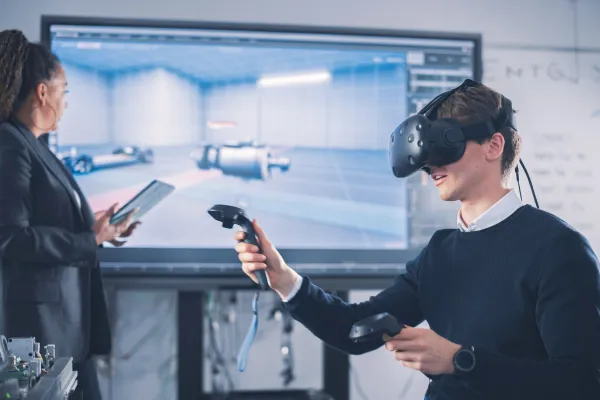
Das Kernthema Digitalisierung steht für tiefgreifende gesellschaftliche Veränderungen. Digitale Technologien wie künstliche Intelligenz, Blockchain oder Smart Services prägen neue Formen des Arbeitens, Wirtschaftens und Zusammenlebens. Die differenzierte Auseinanderseztung mit der Digitalisierung berücksichtigt dabei auch soziale und ökologische Auswirkungen.

Digitalisierung bedeutet unter anderem Online-Shopping auf Knopfdruck, sekundenschnelle Antworten auf beliebige Fragen dank „Künstlicher Intelligenz (KI), Videogespräche mit Freunden sowie das Trainieren von KI auf medizinischen Daten, um Leben zu retten. Mein Team arbeitet daran, die Digitalisierung durch greifbare Innovationen voranzutreiben und auch Wissen zu generieren, um Chancen und Risiken besser zu verstehen."
Digitalisierung in Forschung und Transfer
An der Universität Liechtenstein ist Digitalisierung ein zentrales Kernthema in Forschung und Transfer. Der Fokus liegt auf der Entwicklung und Bewertung digitaler Innovationen, die zur nachhaltigen Transformation beitragen. Die Forschung adressiert aktuelle Fragestellungen der digitalen Transformation in Bereichen wie Architektur und Rau,mentwicklung, Wirtschaftswissenschaften, Recht und Gesellschaft. So entstehen neue Lösungsansätze für die Gestaltung einer digitalen und zugleich verantwortungsvollen Zukunft. Im Zentrum stehen anwendungsorientierte Projekte, interdisziplinäre Zusammenarbeit und der direkte Dialog mit Wirtschaft und Gesellschaft.

Digitalisierung prägt zunehmend das Wirtschaftsleben und stellt das Strafrecht vor neue Herausforderungen. Meine Forschung und Lehre umfassen das Wirtschafts- und Cyberstrafrecht sowie aktuelle Regulierungen wie DORA und MiCAR. Zugleich stehen technologische Innovationen wie Blockchain und Künstliche Intelligenz ebenso im Fokus wie deren strafrechtliche und Compliance-relevante Implikationen."
Forschungs- und Transferprojekte im Bereich Digitalisierung
Auswahl unserer Publikationen zu Digitalisierung
-
Schaunig, G. (2025). House Searches and Seizures in Criminal Proceedings: The Perspective of an Effective Protection of Fundamental Rights with a Focus on Mobile Devices and Data. University of Vienna Law Review, 9(1), 20-54.Weitere
-
Ebner, F., Aubrunner, F., & Kalss, S. (2025). Diskussionsentwurf für ein Gesetz über digitale Wertpapiere und digitale Werte (Teil I). Der Gesellschafter(3), 170.Weitere
-
Ebner, F., Aubrunner, F., & Kalss, S. (2025). Diskussionsentwurf für ein Gesetz über digitale Wertpapiere und digitale Werte (Teil II). Der Gesellschafter(5).Weitere
-
Ebner, F., Aubrunner, F., & Brameshuber, G. (2025). Tagungsbericht zur 3. Digital Assets Rechtstagung: Der neue EU-Regelungsrahmen für Kryptowerte und das digitale Finanzwesen. Der Gesellschafter - Zeitschrift für Gesellschafts- und Unternehmensrecht (GesRZ)(2), 109-113.Weitere
-
Mlcoch, J., & Schaunig, G. (2025). Besonderer Steuersatz auch für GmbH-Optionen? taxlex: Fachzeitschrift für Steuerrecht(12), 388-393.Weitere
-
Piotrowski, P., & Stockhammer, D. (2025). BIM-enabled material reuse: Needs and barriers from a SwissLiechtenstein perspective. Phase0 - Journal für integriertes Planen, Bauen und Betreiben(3).Weitere
-
Papathanasiou, K. (2025). Cyberresilienz und Strafrecht - DORA zwischen Prävention und Sanktion. Liechtensteinische Juristen-Zeitung, 46(1), 7-20.Weitere
-
vom Brocke, J., Franzoi, S., Kipping, G., & Grisold, T. (2025). Managing Business Processes in Times of Continuous Change. Balancing Emergence and Control. CONTROLLING - Zeitschrift für erfolgsorientierte Unternehmenssteuerung, 37(1), 11-17.Weitere
-
Ballandies, M. C., Holzwarth, V., Sunderland, B., Pournaras, E., & vom Brocke, J. (2025). Advancing Customer Feedback Systems with Blockchain - When Design Science Research Meets Value-Sensitive Design. Business & Information Systems Engineering, 67, 449-471.Weitere
-
Schadner, W. (2025). Hurst Exponent as Implied by Option Prices. Studies in Nonlinear Dynamics & Econometrics.Weitere
-
Ebrahimi, P., & Schneider, J. (2025). Fine-Tuning Image-to-Text Models on Liechtenstein Tourist Attractions. Electronic Markets, 35(55).Weitere
-
Angerer, M., Gramlich, M., & Hanke, M. (2025). Order Book Liquidity on Crypto Exchanges. Journal of Risk and Financial Management, 18(3).Weitere
-
Isci, J., & Hirtenlehner, J. (2025). Die Verwendung von Kunden-Kryptowerten auf eigene Rechnung. BKR - Zeitschrift für Bank- und Kapitalmarktrecht(8), 337-384.Weitere
-
Hacker, J., Trier, M., & Richter, A. (2024). Unfolding the contextual nature of enterprise social media use - a morphogenetic approach. European Journal of Information Systems, 33(6), 921-952.Weitere
-
Ebner, F., Aubrunner, F., & Brameshuber, G. (2024). Tagungsbericht zur 2. Digital Assets Rechtstagung: Digital Assets im Privatrecht - in Österreich und im internationalen Vergleich. Der Gesellschafter - Zeitschrift für Gesellschafts- und Unternehmensrecht (GesRZ)(3), 160-162.Weitere
-
Schadner, W. (2024). Direct Fit for SVI Implied Volatilities. Journal of Derivatives, 31(3).Weitere
-
Liegl, S., & Furtner, M. (2024). Emotional leader communication in the digital age: An experimental investigation on the role of emoji. Computers in Human Behavior, 154, 108148.Weitere
-
Schneider, J., Meske, C., & Kuss, P. (2024). Foundation Models. Business & Information Systems Engineering, 66, 221-231.Weitere
-
Nigg-Stock, A., Bayrle, N., & Brecht, L. (2023). Drivers of exploitative and explorative innovation efficiency. Digital Business, 3(2).Weitere
-
Weinmann, M., Mishra, A., Kaiser, L., & vom Brocke, J. (2023). Attraction Effect in Crowd-funding: Evidence from Eight Studies. Information Systems Research (ISR), 34(3).Weitere
-
Lettenbichler, M., Brüstle, J. L., & Jörg, M. (2023). Kryptokunst im Fürstentum Liechtenstein. Spektrum des Wirtschaftsrechts, 21-27.Weitere
-
Chandra Kruse, L., Bergener, K., Conboy, K., Lundström, J. E., Maedche, A., Sarker, S., Seeber, I., Stein, A., & Tømte, C. E. (2023). Understanding the Digital Companions of Our Future Generation. Communications of the Association for Information Systems(52).Weitere
-
Angerer, M., Neugebauer, T., & Shachat, J. (2023). Arbitrage bots in experimental asset markets. Journal of Economic Behavior & Organization, 206, 262-278.Weitere
-
Lettenbichler, M. (2023). Zulässigkeit von Smart Contracts in der österreichischen Versicherungsrechtsdogmatik. Zeitschrift für Versicherungsrecht, 3, 98-104.Weitere
-
Kosolapova, M., Hanke, M., & Weissensteiner, A. (2023). Estimating time-varying risk aversion from option prices and realized returns. Quantitative Finance, 23(1), 1-17.Weitere
-
Hacker, J., Miscione, G., Felder, T., & Schwabe, G. (2023). Commit or Not? How Blockchain Consortia Form and Develop. California Management Review, 65(3), 110-131.Weitere
-
Thies, F., Wallbach, S., Wessel, M., Besler, M., & Benlian, A. (2022). Initial coin offerings and the cryptocurrency hype - the moderating role of exogenous and endogenous signals. Electronic Markets, 32, 1691-1705.Weitere
-
Jörg, M. (2022). Blockchain-Technologie und liechtensteinisches Immaterialgüterrecht. Spektrum des Wirtschaftsrechts, 321-329.Weitere
-
Raschner, P. (2022). Das (neue) Marktmanipulationsrecht für Kryptowerte. Zeitschrift für Bank- und Kapitalmarktrecht, 217-224.Weitere
-
Schopper, A., & Raschner, P. (2022). Privat- und aufsichtsrechtliche Rahmenbedingungen für Krypto-Banking. BankArchiv. Zeitschrift für das gesamte Bank- und Börsenwesen, 262-277.Weitere
-
Schadner W. and Traut J. (2022). Estimating Forward-Looking Stock Correlations from Risk Factors. Mathematics, 10(10), 1-19.Weitere
-
Linardatos, D. (2022). Einwendungen und Ausschlussgründe bei elektronischen Wertpapieren. Zeitschrift für Bank- und Kapitalmarktrecht(7), 486-493.Weitere
-
Reibenspiess, V., Drechsler, K., Eckhardt, A., & Wagner, H.-T. (2022). Tapping into the wealth of employees‘ ideas: Design principles for a digital intrapreneurship platform. Information and Management, 59(3).Weitere
-
Angerer, M., Herrmann-Romero, M., & Szymczak, W. (2022). Losing funds or losing face? Reputation and accountability in the credit rating industry. Journal of Economic Dynamics and Control, 143, 1-32.Weitere
-
Schadner, W. (2022). U.S. Politics from a multifractal perspective. Chaos, Solitons & Fractals, 155(111677), 1-11.Weitere
-
Burtscher, B. (2022). Missbrauch von Zahlungskarten zwischen Aufsichtsrecht, Zivilrecht und Vertragsgestaltung. BankArchiv(1), 20-31.Weitere
-
Lettenbichler, M. (2022). Kryptowährungen im Kontext der liechtensteinischen Stiftung. Liechtensteinische Juristen-Zeitung(4), 229-233.Weitere
-
Lettenbichler, M. (2022). Der automationsunterstützte Vertragsschluss im Rechtsvergleich des liechtensteinischen, österreichischen und schweizerischen Vertrags- und Verbraucherrechts. Zeitschrift für Europarecht, Internationales Privatrecht und Rechtsvergleichung, ZfRV(5), 210 - 215.Weitere
-
Linardatos, D., Pfisterer, N., & Pfurtscheller, V. (2022). Zur Regulierung der Schwarmfinanzierungsdienstleistungen durch die europäische Crowdfunding-Verordnung. Liechtensteinische Juristen-Zeitung(4), 234-248.Weitere
-
Lettner, N., Wilhelm, S., Güldenberg, S., & Güttel, W. (2022). Customers as knowledge partners in a digital business ecosystem: From customer analytics towards knowledge partnerships. Journal of Digital Economy, 1(2), 130-140.Weitere
-
Ebner, F. (2022). Finanzinstrumente auf der Blockchain: Die neue EU-Pilotregelung für DLT-Marktinfrastrukturen im Überblick. Der Gesellschafter - Zeitschrift für Gesellschafts- und Unternehmensrecht (GesRZ), 271-281.Weitere
-
Ebner, F. (2022). Die österreichische digitale Sammelurkunde. RDi - Recht Digital (3), 108 - 115.Weitere
-
Pufahl, L., Zerbato, F., Weber, B., & Weber, I. (2022). BPMN in healthcare: Challenges and best practices. Information Systems, 107.Weitere
-
Schurr, F., & Layr, A. (2022). Emission und Übertragung von DLT-Wertrechten im internationalen Privatrecht Liechtensteins und der Schweiz. Zeitschrift für Vergleichende Rechtswissenschaft(121, 2022), 32-51.Weitere
-
Chandra Kruse, L., & Drechsler, K. (2022). Digitalization of Multisensory Collective Activity: The Case of Virtual Wine Tasting. Journal of Information Technology, 37(4), 341-358.Weitere
-
Bellhäuser, H., Liborius, P., & Schmitz, B. (2022). Fostering Self-Regulated Learning in Online Environments: Positive Effects of a Web-Based Training With Peer Feedback on Learning Behavior. Frontiers in Psychology, 13.Weitere
-
Maran, T. K., Liegl, S., Davila, A., Moder, S., Kraus, S., & Mahto, R. V. (2022). Who fits into the digital workplace? Mapping digital self-efficacy and agility onto psychological traits. Technological Forecasting and Social Change, 175(2), 121352.Weitere
-
Blanka, C., Krumay, B., & Rueckel, D. (2022). The interplay of digital transformation and employee competency: A design science approach. Technological Forecasting and Social Change, 178.Weitere
-
Seiger, R., Malburg, L., Weber, B., & Bergmann, R. (2022). Integrating process management and event processing in smart factories: A systems architecture and use cases. Journal of Manufacturing Systems, 63, 575-592.Weitere
-
Beverungen, D., Buijs, J., Becker, J., Di Ciccio, C., van der Aalst, W., Bartelheimer, C., vom Brocke, J., Comuzzi, M., Kraume, K., Leopold, H., Matzner, M., Mendling, J., Ogonek, N., Post, T., Resinas, M., Revoredo, K., del-Río-Ortega, A., La Rosa, M., Santoro, F., Solti, A., Song, M., Stein, A., Stierle, M., & Wolf, V. (2021). Seven Paradoxes of Business Process Management in a Hyper-Connected World. Business & Information Systems Engineering, 63, 145-156.Weitere
-
Franck, J.-U., & Linardatos, D. (2021). Germany’s ‘Lex Apple Pay’: Payment Services Regulation Overtakes Competition Enforcement. Journal of European Competition Law & Practice, 12(2), 68–81.Weitere
-
Lettenbichler, M. (2021). Smart Contracts und Blockchain im Spannungsverhältnis mit dem Verbraucherschutz. Spektrum des Wirtschaftsrechts(2021), 305-313.Weitere
-
Damjanovic, D., Pfurtscheller, V., & Raschauer, N. (2021). Liechtensteins "Blockchain-Regulierung". Zeitschrift für Europäisches Privatrecht(2), 397.Weitere
-
Piening, E. P., Thies, F., Wessel, M., & Benlian, A. (2021). Searching for Success- Entrepreneurs' Responses to Crowdfunding Failure. Entrepreneurship Theory and Practice, 45(3).Weitere
-
Schopper, A., & Raschner, P. (2021). Kryptowährungen in der Bankbilanz. Liechtensteinische Juristen Zeitung, 209-222.Weitere
-
Grisold, T., Mendling, J., Otto, M., & vom Brocke, J. (2021). Adoption, Use and Management of Process Mining in Practice. Business Process Management Journal, 27(2), 369-387.Weitere
-
Angerer, M., Hoffmann, C., Neitzert, F., & Kraus, S. (2021). Objective and Subjective Risks of Investing into Cryptocurrencies. Finance Research Letters, 40(101737).Weitere
-
Pfurtscheller, V., Raschauer, N., & Stern, T. (2021). Von regulatorischen Sandplätzen und Innovationsknotenpunkten - rechtsvergleichende Bemerkungen zur Förderung von Fintechs in der DACH-Region. Zeitschrift für Finanzmarktrecht (ZFR)(1).Weitere
-
Plattfaut, R., Stein, A., & Bergener, K. (2021). Hochschulübergreifende Digitale Lehr-/Lernkonzepte zum Geschäftsprozessmanagement – Herausforderungen und Lessons Learned. HMD - Praxis der Wirtschaftsinformatik, 58, 1456–1468.Weitere
-
Layr, A. (2021). Tokenization of Assets: Security Tokens in Liechtenstein and Switzerland. Milan Law Review, 2(1 (Wiederabdruck)), 45-72.Weitere
-
Schneider, C., Weinmann, M., Mohr, P., & vom Brocke, J. (2021). When the stars shine too bright: Assessing the influence of dimensional ratings on overall product ratings. Management Science, 67(6).Weitere
-
Walch, A. (2021). SME Funding through Tokenization under the Liechtenstein Token and TT Service Provider Act: Legal Requirements, Market Sentiment and Business Concept. Spektrum des Wirtschaftsrechts, 2021, 161-213.Weitere
-
Drechsler, K., Reibenspiess, V., Eckhardt, A., & Wagner, H.-T. (2021). Innovation Champions' Activities and Influences in Organizations - A Literature Review. International Journal of Innovation Management, 25(6).Weitere
-
Coombs, C., Stacey, P., Kawalek, P., Simeonova, B., Becker, J., Bergener, K., Carvalho, J. Á., Fantinato, M., Garmann-Johnsen, N. F., Grimme, C., Stein, A., & Trautmann, H. (2021). What Is It About Humanity That We Can’t Give Away To Intelligent Machines? A European Perspective. International Journal of Information Management, 58, 102311.Weitere
-
Raschner, P., & Reheis, J. (2021). Die Einführung der digitalen Sammelurkunde. Vom Wertpapier(recht) zum Wertrecht? BankArchiv. Zeitschrift für das gesamte Bank- und Börsenwesen.Weitere
-
Schadner, W. (2021). On the persistence of market sentiment: A multifractal fluctuation analysis. Physica A, 581(126242), 1-14.Weitere
-
Werner, F., Basalla, M., Schneider, J., Hays, D., & vom Brocke, J. (2021). Blockchain Adoption from an Interorganizational Systems Perspective - A Mixed-Methods Approach. Information Systems Management, 38(2), 135-150.Weitere
-
Lang, S., & Schadner, W. (2021). The trilemma of expansionary monetary policy in the Euro area during the COVID-19 crisis. Finance Research Letters, 42(102048), 1-4.Weitere
-
Hacker, J., & Riemer, K. (2021). Identification of User Roles in Enterprise Social Networks: Method Development and Application. Business & Information Systems Engineering, 63, 367-387.Weitere
-
Schadner, W. (2021). Forward looking up-/down correlations. Quantitative Finance and Economics, 5(3), 471-495.Weitere
-
Holzwarth, V., Schneider, J., Handali, J., Gisler, J., Hirt, C., Kunz, A., & vom Brocke, J. (2021). Towards estimating affective states in Virtual Reality based on behavioral data. Virtual Reality, 25, 1139–1152.Weitere
-
Lettenbichler, M. (2021). Zulässigkeit einer virtuellen Generalversammlung der liechtensteinischen Aktiengesellschaft. Liechtensteinische Juristen-Zeitung(3), 102-108.Weitere
-
Schadner, W. (2021). Ex-Ante Risk Factors and Required Structures of the Implied Correlation Matrix. Finance Research Letters, 41(101855), 1-8.Weitere
-
vom Brocke, J., Baier, M., Schmiedel, T., Stelz, K., Röglinger, M., & Wehking, C. (2021). Context-Aware Business Process Management. Business & Information Systems Engineering, 63(5), 533-550.Weitere
-
Kamm, M., Kucklick, J., Schneider, J., & vom Brocke, J. (2021). Data mining for small shops: Empowering brick-and-mortar stores through BI functionalities of a loyalty program. Information Systems Management, 38(4), 270-286.Weitere
-
Russo, M., Srndic, N., & Laskov, P. (2021). Detection of illicit cryptomining using network metadata. EURASIP Journal on Information Security(11).Weitere
-
Burtscher, B. (2021). Haftung des Zahlungsdienstleisters: abschließende Regelung durch die Zahlungsdiensterichtlinie? Kritische Anmerkungen zu EuGH C-337/20, CRCAM. Zeitschrift für Finanzmarktrecht(10).Weitere
-
Gerster, D., Dremel, C., Conboy, K., Mayer, R., & vom Brocke, J. (2021). How Fujitsu and Four Fortune 500 Companies Managed Time Complexities Using Organizational Agility. MIS Quarterly Executive, 20(2).Weitere
-
Howe, L. B. (2021). Thinking through people: The potential of volunteered geographic information for mobility and urban studies. Urban Studies, 58(14), 3009-3028.Weitere
-
Ebner, F. (2021). (R)evolution im Nachbarland: Das deutsche Gesetz über elektronische Wertpapiere. Der Gesellschafter - Zeitschrift für Gesellschafts- und Unternehmensrecht (GesRZ), 228 - 240.Weitere
-
vom Brocke, J., Weber, M., & Grisold, T. (2021). Class Notes: The BPM Context Matrix - A Framework for Context-Aware Business Process Management (BPM). BPTrends: BPM analysis, opinion and insight.Weitere
-
Combi, C., Oliboni, B., & Zerbato, F. (2021). Seamless conceptual modeling of processes with transactional and analytical data. Data & Knowledge Engineering, 134.Weitere
-
Burtscher, B. (2021). DSGVO und immaterielle Schäden: erste internationale Entwicklungen. Zeitschrift für europäisches Privatrecht, 698-711.Weitere
-
Linardatos, D. (2021). Kontaktloses Zahlen im Zahlungsdiensterecht - ein Überblick über die zivil- und aufsichtsrechtlichen Regeln. BKR - Zeitschrift für Bank- und Kapitalmarktrecht, 2021(11), 665-675.Weitere
-
vom Brocke, J., Rosemann, M., Mendling, J., & Weber, M. (2021). Class Notes: The BPM Billboard - A Tool for Planning and Scoping BPM Initatives. BPTrends: BPM analysis, opinion and insight.Weitere
-
Mendling, J., Berente, N., Seidel, S., & Grisold, T. (2021). The Philosopher's Corner: Pluralism and Pragmatism in the Information Systems Field: The Case of Research on Business Processes and Organizational Routines. The Data Base for Advances in Information Systems, 52(2), 127-140.Weitere
-
Hora, W., & Klammer, A. (2021). Höher, schneller, weiter? Eine empirische Analyse des strategischen Managements von schnell wachsenden Jungunternehmen. Zeitschrift für KMU und Entrepreneurship, 69(3), 169-186.Weitere
-
Basalla, M., Schneider, J., Luksik, M., Jaakonmäki, R., & vom Brocke, J. (2021). On Latency of E-Commerce Platforms. Journal of Organizational Computing and Electronic Commerce, 31(1), 1 - 17.Weitere
-
Grisold, T., vom Brocke, J., Groß, S., Mendling, J., Röglinger, M., & Stelzl, K. (2021). Digital Innovation and Business Process Management: Opportunities and Challenges as Perceived by Practitioners. Communications of the Association for Information Systems, 49, 556 – 571.Weitere
-
Simons, A., Wohlgenannt, I., Weinmann, M., & Fleischer, S. (2021). Good gamers, good managers? A proof-of-concept study with Sid Meier's Civilization. Review of Managerial Science, 15, 957-990.Weitere
-
Sild, J. E. (2020). Blockchain Regulation made in Liechtenstein. Das Fürstentum als Vorreiter? Spektrum des Wirtschaftsrechts, 45-63.Weitere
-
Linardatos, D. (2020). Die Einbeziehung von AGB im digitalen Rechtsverkehr mit Verbrauchern. JuristenZeitung (JZ), 75(22), 1097-1106.Weitere
-
Kaiser, L., & Stöckl, S. (2020). Cryptocurrencies: Herding and the Transfer Currency. Finance Research Letters, 33.Weitere
-
Schadner, W. (2020). An idea of risk-neutral momentum and market fear. Finance Research Letters, 37(101347), 1-6.Weitere
-
Ebner, F., & Kalss, S. (2020). Die digitale Sammelurkunde – ein erster Schritt zur vollsta¨ndigen Digitalisierung des o¨sterreichischen Wertpapierrechts. Der Gesellschafter - Zeitschrift für Gesellschafts- und Unternehmensrecht (GesRZ), 369 - 380.Weitere
-
Linardatos, D. (2020). Elektronische Schuldverschreibungen auf den Inhaber - des Wertpapiers neue Kleider. ZBB - Zeitschrift für Bankrecht und Bankwirtschaft/Journal of Banking Law and Banking, 32(6), 329-347.Weitere
-
Hanke, M., Stöckl, S., & Weissensteiner, A. (2020). Political Event Portfolios. Journal of Banking and Finance, 118, 1-18.Weitere
-
Hacker, J., vom Brocke, J., Handali, J., Otto, M., & Schneider, J. (2020). Virtually in this together – how web-conferencing systems enabled a new virtual togetherness during the COVID-19 crisis. European Journal of Information Systems, 29(5), 563-584.Weitere
-
Hanke, M., Kosolapova, M., & Weissensteiner, A. (2020). COVID-19 and Market Expectations: Evidence from Option-Implied Densities. Economics Letters, 195, 1-4.Weitere
-
Betzing, J. H., Tietz, M., vom Brocke, J., & Becker, J. (2020). The impact of transparency on mobile privacy decision making. Electronic Markets, 30, 607-625.Weitere
-
Werder, K., Seidel, S., Recker, J., Berente, N., Gibbs, J., Abboud, N., & Benzeghadi, Y. (2020). Data-Driven, Data-Informed, Data-Augmented: How Ubisoft's Ghost Recon Wildlands Live Unit Uses Data for Continuous Product Innovation. California Management Review, 62(3).Weitere
-
Innerhofer, B., Jörg, M., Lettenbichler, M., & Reheis, J. (2020). Die virtuelle Wohnungseigentümerversammlung. Immolex : neues Miet- und Wohnrecht(6), 177-181.Weitere
-
Gregor, S., Chandra Kruse, L., & Seidel, S. (2020). Research Perspectives: The Anatomy of a Design Principle. Journal of the Association for Information Systems, 21(6), 1622-1652.Weitere
-
Thies, F., Huber, A., Bock, C., & Benlian, A. (2020). Trusting the crowd: Effects of crowdfunding on venture capital syndicates. Journal of Small Business Management.Weitere
-
Seidel, S., & Watson, R. (2020). Integrating Explanatory/Predictive and Prescriptive Science in Information Systems Research. Communications of the Association for Information Systems, 47(1).Weitere
-
Lins, B., & Praicheux, S. (2020). Digital and blockchain-based legal regimes: An EEA case study based on innovative legislations – comparison of French and Liechtenstein domestic regulations. Spektrum des Wirtschaftsrechts.Weitere
-
Dremel, C., Herterich, M., Wulf, J., & vom Brocke, J. (2020). Actualizing Big Data Analytics Affordances: A Revelatory Case Study. Information and Management, 57(1).Weitere
-
Layr, A. (2020). Tokenization of Assets: Security Tokens in Liechtenstein and Switzerland. Spektrum des Wirtschaftsrechts, 121-132.Weitere
-
Schmiedel, T., Recker, J., & vom Brocke, J. (2020). The relation between BPM culture, BPM methods, and process performance: Evidence from quantitative field studies. Information and Management, 57(2), 103175.Weitere
-
Badakhshan, P., Conboy, K., Grisold, T., & vom Brocke, J. (2020). Agile business process management: A systematic literature review and an integrated framework. Business Process Management Journal, 26(6).Weitere
-
Drechsler, K., Gregory, R. W., Wagner, H.-T., & Tumbas, S. (2020). At the crossroads between digital innovation and digital transformation. Communications of the Association for Information Systems, 47, 521-538.Weitere
-
vom Brocke, J., Schmid, A., Simons, A., & Safrudin, N. (2020). IT-enabled organizational transformation: a structured literature review. Business Process Management Journal, 27(1).Weitere
-
Lettenbichler, M., & Jörg, M. (2020). Der «Dash Smart Shelf» aus Sicht der liechtensteinischen Vertragsrechtsdogmatik. Liechtensteinische Juristen-Zeitung(3), 232-239.Weitere
-
Haki, K., Beese, J., Aier, S., & Winter, R. (2020). The Evolution of Information Systems Architecture: An Agent-Based Simulation Model. MIS Quarterly, 44(1a), 155-184.Weitere
-
Lins, B. (2020). Robo Advice - Aufsichtsrechtliche Pflichten der digitalen Anlageberatung und Vermögensverwaltung. BKR - Zeitschrift für Bank- und Kapitalmarktrecht, 20(4), 181-186.Weitere
-
Butterstein, A., Jörg, M., & Lettenbichler, M. (2020). Das Smart Home im liechtensteinischen Versicherungsrecht. Spektrum des Wirtschaftsrechts, 499-510.Weitere
-
Fischer, M., Helm, D., Hofmann, A., Janiesch, C., Klima, C., & Winkelmann, A. (2020). A taxonomy and archetypes of smart services for smart living. Electronic Markets, 30, 131-149.Weitere
-
Linardatos, D. (2020). Robos Rat - über digitale Berater und Vermögensverwalter und zum Nutzen der Robo Advisor für Unternehmer. return - Magazin für Transformation und Turnaround, 2020(2).Weitere
-
Vom Brocke, J., Hevner, A., Léger, P. M., Walla, P., & Riedl, R. (2020). Advancing a NeuroIS Research Agenda with Four Areas of Societal Contributions. European Journal of Information Systems, 29(1), 9-24.Weitere
-
Seidel, S., Berente, N., Lindberg, A., Lyytinen, K., Martinez, B., & Nickerson, J. V. (2020). Artificial Intelligence and Video Game Creation: A Framework for the New Logic of Autonomous Design. Journal of Digital Social Research, 2(3), 126-157.Weitere
-
Cheng, X., Fu, S., De Vreede, T., De Vreede, G.-J., Seeber, I., Maier, R., & Weber, B. (2020). Idea Convergence Quality in Open Innovation Crowdsourcing: A Cognitive Load Perspective. Journal of Management Information Systems, 37(2), 349–376.Weitere
-
Linardatos, D. (2020). Rollende Kreditkarten - zahlungsdienstrechtliche Fragen bei In-Car-Payments. RdZ - Recht der Zahlungsdienste, 36-43.Weitere
-
Apruzzese, G., Andreolini, M., Colajanni, M., & Marchetti, M. (2020). Hardening Random Forest Cyber Detectors Against Adversarial Attacks. IEEE Transactions on Emerging Topics in Computational Intelligence, 4(4), 427-439.Weitere
-
Schopper, A., & Raschner, P. (2019). Die aufsichtsrechtliche Einordnung von Krypto-Börsen in Österreich. BankArchiv. Zeitschrift für das gesamte Bank- und Börsenwesen, 249-265.Weitere
-
Harr, A., vom Brocke, J., & Urbach, N. (2019). Evaluating the individual and organizational impact of enterprise content management systems. Business Process Management Journal, 25(7), 1413-1440.Weitere
-
Caramanica, L., & Raschner, P. (2019). Zur Einrichtung einer Regulatory Sandbox für FinTechs im österreichischen und europäischen Aufsichtsrecht. Wirtschaftsrechtliche Blätter.Weitere
-
Beverungen, D., Müller, O., Matzner, M., Mendling, J., & vom Brocke, J. (2019). Conceptualizing smart service systems. Electronic Markets, 29(1), 7-18.Weitere
-
Papathanasiou, K. (2019). Erlaubnispflichtigkeit von Bankgeschäften, strafrechtliche Irrtumslehre und die Herausforderung der Kryptowährungen - Anlässlich von BGH 2 StR 416/16 - 18.7.2018. Juristische Rundschau, 369-373.Weitere
-
Abraham, R., Schneider, J., & vom Brocke, J. (2019). Data governance: A conceptual framework, structured review, and research agenda. International Journal of Information Management, 49(Dec), 424-438.Weitere
-
Hacker, J., Johnson, M., Saunders, C., & Thayer, A. (2019). Trust in Virtual Teams: A Multidisciplinary Review and Integration. Australasian Journal of Information Systems, 23.Weitere
-
Berente, N., Seidel, S., & Safadi, H. (2019). Research Commentary - Data-Driven Computationally-Intensive Theory Development. Information Systems Research (ISR), 30(1), 50-64.Weitere
-
Simons, A., Kaiser, L. F., & vom Brocke, J. (2019). Enterprise crowdfunding: Foundations, applications, and research findings. Business & Information Systems Engineering, 61(1), 113-121.Weitere
-
Seidel, S., Berente, N., Lindberg, A., Lyytinen, K., & Nickerson, J. (2019). Autonomous Tools and Design: A Triple-Loop Approach to Human-Machine Learning. Communications of the ACM, 62(1), 50-57.Weitere
-
Gorbacheva, E., Beekhuyzen, J., vom Brocke, J., & Becker, J. (2019). Directions for research on gender imbalance in the IT profession. European Journal of Information Systems, 28(1), 43-67.Weitere
-
Layr, A., & Marxer, M. (2019). Rechtsnatur und Übertragung von "Token" aus liechtensteinischer Perspektive. Liechtensteinische Juristen-Zeitung(1), 11-19.Weitere
-
Thies, F., Huber, A., Bock, C., Benlian, A., & Kraus, S. (2019). Following the Crowd — Does Crowdfunding Affect Venture Capitalists’ Selection of Entrepreneurial Ventures? Journal of Small Business Management, 57(4), 1378-1398.Weitere
-
Schurr, F. (2019). Digitalisierung im Gesellschaftsrecht in der EU: Quo vadis? Europäische Zeitschrift für Wirtschaftsrecht(18), 772-779.Weitere
-
Niemand, T., Kraus, S., Angerer, M., Thies,Ferdinand, & Mas-Tur, A. (2019). More is not always better—non-linear effects in crowdfunding. International Journal of Quality Innovation, 5(6), 1-10.Weitere
-
Blaschke, M., Riss, U., Haki, K., & Aier, S. (2019). Design Principles for Digital Value Co-creation networks: A Service-dominant Logic Perspective. Electronic Markets, 29, 443-472.Weitere
-
Schurr, F. (2019). Anbahnung, Abschluss und Durchführung von Smart Contracts im Rechtsvergleich. Zeitschrift für Vergleichende Rechtswissenschaft(3), 257-284.Weitere
-
Linardatos, D. (2019). Künstliche Intelligenz und Verantwortung. ZIP - Zeitschrift für Wirtschaftsrecht(11), 504-509.Weitere
-
Angerer, M., & Szymczak, W. (2019). The impact of endogenous and exogenous cash inflows in experimental asset markets. Journal of Economic Behavior & Organization, 166, 216-238.Weitere
-
Burattin, A., Kaiser, M., Neurauter, M., & Weber, B. (2019). Learning process modeling phases from modeling interactions and eye tracking data. Data and Knowledge Engineering, 121, 1-17.Weitere
-
Meyer-Brötz, F., Stelzer, B., Schiebel, E., & Brecht, L. (2018). Mapping the technology and innovation management literature using hybrid bibliometric networks. International Journal of Technology Management (IJTM), 77(4).Weitere
-
Niemand, T., Angerer, M., Thies, F., Kraus, S., & Hebenstreit, R. (2018). Equity crowdfunding across borders: A conjoint experiment. International Journal of Entrepreneurial Behavior & Research, 24(4), 911-932.Weitere
-
Angerer, M., Peter, G., Stöckl, S., Wachter, T., Bank, M., & Menichetti, M. (2018). Bid-Ask Spread Patterns and the Optimal Timing for Discretionary Liquidity Traders on Xetra. Schmalenbachs Zeitschrift für betriebswirtschaftliche Forschung (ZfbF), 70(3), 209-230.Weitere
-
Gentner, D., Stelzer, B., Ramosaj Bujar, & Brecht, L. (2018). Strategic Foresight of Future B2B Customer Opportunities through Machine Learning. Technology Innovation Management Review, 8(10), 5-17.Weitere
-
Jaakonmäki, R., Simons, A., Müller, O., & vom Brocke, J. (2018). ECM Implementations in Practice: Objectives, Processes, and Technologies. Journal of Enterprise Information Management (JEIM), 31(5), 704-723.Weitere
-
Grottke, M., Hacker, J., & Durst, C. (2018). Which factors determine our online social capital? An analysis based on structural equation modeling. Australasian Journal of Information Systems, 22.Weitere
-
Seidel, S., Chandra Kruse, L., Székely, N., Gau, M., & Stieger, D. (2018). Design principles for sensemaking support systems in environmental sustainability transformations. European Journal of Information Systems, 27(2), 221-247.Weitere
-
Lins, B. (2018). Robo-Advice - Regulatorische und aufsichtsrechtliche Herausforderungen für Liechtenstein. Spektrum des Wirtschaftsrechts, 11-47.Weitere
-
Thies, F., Wessel, M., & Benlian, A. (2018). Network effects on crowdfunding platforms: Exploring the implications of relaxing input control. Information Systems Journal (ISJ), 28(6), 1239-1262.Weitere
-
Seidel, S., Berente, N., Martinez, B., Lindberg, A., Lyytinen, K., & Nickerson, J. (2018). Autonomous Tools in Systems Design: Reflective Practice in Ubisoft's Ghost Recon Wildlands Project. IEEE Computer, 51(10), 16-23.Weitere
-
vom Brocke, J., Basalla, M., Kaiser, L. F., Schneider, J., Ragtschaa, S., Batliner-Staber, F., & Dzinic, E. (2018). Own - The Case of a Blockchain Business Model Disrupting the Equity Market. CONTROLLING - Zeitschrift für erfolgsorientierte Unternehmenssteuerung, 30(5), 19-25.Weitere
-
Schneider, C., Weinmann, M., & vom Brocke, J. (2018). Digital Nudging-Influencing Choices by Using Interface Design. Communications of the ACM, 61(7), 67-73.Weitere
-
Salahaldin, L., Angerer, M., Kraus, S., & Trabelsi, D. (2018). A duration-based model of crowdfunding project choice. Finance Research Letters, 29, 404-410.Weitere
-
Müller, O., Fay, M., & vom Brocke, J. (2018). The effect of big data and analytics on firm performance: An econometric analysis considering industry characteristics. Journal of Management Information Systems, 35(2), 488-509.Weitere
-
Whelan, E., McDuff, D., Gleasure, R., & vom Brocke, J. (2018). How Emotion-Sensing Technology Can Reshape the Workplace. MIT Sloan Management Review, 59(3), 7-10.Weitere
-
Raschauer, N., & Stern, T. (2018). Audit rights of the internal bank audit in cross-border situations. Spektrum des Wirtschaftsrechts(2018), 113-124.Weitere
-
Suomi, R., Müller, O., & vom Brocke J. (2018). Hospital-wide Process-oriented Organization of Care: The Case of Turku University Central Hospital. Journal of Information Technology Theory and Application, 19(4), 32-55.Weitere
-
Hora, W., Gast, J., Kailer, N., Rey-Marti, A., & Mas-Tur, A. (2018). David and Goliath: causes and effects of coopetition between start-ups and corporates. Review of Managerial Science, 12(2), 411-439.Weitere
-
Lehrer, C., Wieneke, A., vom Brocke, J., Jung, R., & Seidel, S. (2018). How Big Data Analytics Enables Service Innovation: Materiality, Affordance, and the Individualization of Service. Journal of Management Information Systems, 35(2), 424-460.Weitere
-
Angerer, M., Niemand, T., Kraus, S., & Thies, F. (2018). Risk-reducing options in crowdinvesting: An experimental study. Journal of Small Business Strategy, 28(3), 1-17.Weitere
-
Morana, S., vom Brocke, J., Maedche, A., Seidel, S., Adam, M. T., Bub, U., Fettke, P., Gau, M., Herwix, A., Mullarkey, M. T., Nguyen, H. D., Sjöström, J., Toreini, P., Wessel, L., & Winter, R. (2018). Tool Support for Design Science Research - Towards a Software Ecosystem: A Report from a DESRIST 2017 Workshop. Communications of the Association for Information Systems, 43(Article 17), 237 - 256.Weitere
-
Kallmuenzer, A., Hora, W., & Peters, M. (2018). Strategic decision-making in family firms: an explorative study. European Journal of International Management, 12(5-6), 655-675.Weitere
-
Hanke, M., & Penev, S. (2018). Comparing Large-Sample Maximum Sharpe Ratios and Incremental Variable Testing. European Journal of Operational Research (EJOR), 265(2), 571-579.Weitere
-
Mendling, J., Weber, I., van der Aalst, W., vom Brocke, J., Cabanillas, C., Daniel, F., Debois, S., Di Ciccio, C., Dumas, M., Dustdar, S., Gal, A., García-Banuelos, L., Goverantori, G., Hull, R., La Rosa, M., Leopold, H., Leymann, F., Recker, J., Reichert, M., Reijers, H., Rinderle-Ma, S., Solti, A., Roseman, M., Schulte, S., Singh, M. P., Slaats, T., Staples, M., Weber, B., Weidlich, M., Weske, M., Xu, X., & Zhu, L. (2018). Blockchains for Business Process Management - Challenges and Opportunities. ACM Transactions on Management Information Systems (TMIS), 9(1), 1-16.Weitere
-
Jaeger, H.-J. (2018). Neuauflage des Kreisschreibens Nr. 13 der ESTV: Securities Lending und Repos. IFF Forum für Steuerrecht(1).Weitere
-
Polivanova-Rosenauer, T., & Linder. (2018). Besteuerung von Kryptowährungen im Privatvermögen in Österreich und in der Schweiz. Recht der Finanzinstrumente (RdF)(3), 239-246.Weitere
-
Tumbas, S., Berente, N., & vom Brocke, J. (2018). Digital Innovation and Institutional Entrepreneurship: Chief Digital Officer Perspectives of their Emerging Role. Journal of Information Technology, 33(3), 188-202.Weitere
-
Linardatos, D. (2018). Smart Contracts - einige klarstellende Bemerkungen. K&R - Kommunikation und Recht(2), 85-92.Weitere
-
Lins, B., & Raschauer, N. (2018). Cloud-Computing – Die Finanzbranche in der Wolke, Teil II. Wertpapiermitteilungen (WM) - Zeitschrift für Wirtschafts- und Bankrecht(50), 2345-2349.Weitere
-
Gentner, D., Stelzer, B., Mahnke, T., Osswald, M., & Brecht, L. (2018). Smart Product-Service Systems und resultierende Anforderungen an das industrielle Produktmanagement. Der Betriebswirt, 59(1).Weitere
-
Gentner, D., Stelzer, B., & Brecht, L. (2017). Potenziale der Erfassung und Analyse von Kundendaten in der verarbeitenden Industrie. ERP Management, 13(4).Weitere
-
Apruzzese, G., Pierazzi, F., Colajanni, M., & Marchetti, M. (2017). Detection and threat prioritization of pivoting attacks in large networks. IEEE Transactions on Emerging Topics in Computing (IEEE TETC), 8(2), 404-415.Weitere
-
Linardatos, D. (2017). BGH: Unwirksamkeit von Scheingeboten bei elektronischer Versteigerung ("Shill-bidding"), Anm. zu BGH, Urteil vom 24.8.2016 - VIII ZR 100/15 (OLG Stuttgart), BeckRS 2016, 20899. LMK - Kommentierte BGH-Rechtsprechung.Weitere
-
Seidel, S., Bharati, P., Fridgen, G., Watson, R. T., Albizri, A., Boudreau, M.-C., Butler, T., Chandra Kruse, L., Guzman, I., Karsten, H., Lee, H., Melville, N., Rush, D., Toland, J., & Watts, S. (2017). The Sustainability Imperative in Information Systems Research. Communications of the Association for Information Systems, 40(3).Weitere
-
Hacker, J., Bodendorf, F., & Lorenz, P. (2017). A framework to identify knowledge actor roles in enterprise social networks. Journal of Knowledge Management, 21(4), 817-838.Weitere
-
Angerer, M., Brem, A., Kraus, S., & Peter, A. (2017). Start-up Funding via Equity Crowdfunding in Germany – A Qualitative Analysis of Success Factors. Journal of Entrepreneurial Finance (JEF), 19(1), 1-33.Weitere
-
Durst, C., Hacker, J., & Berthelmann, T. (2017). Messung der Customer Experience im Ladengeschäft mit Location-based Crowdsourcing und Geofencing. HMD - Praxis der Wirtschaftsinformatik, 54(5), 713-726.Weitere
-
Hacker, J., Wickramasinghe, N., & Durst, C. (2017). Can Health 2.0 Address Critical Healthcare Challenges? Insights from the Case of How Online Social Networks Can Assist in Combatting the Obesity Epidemic. Australasian Journal of Information Systems, 21.Weitere
-
Hibbeln, M., Jenkins, J. L., Schneider, C., Valacich, J. S., & Weinmann, M. (2017). How Is Your User Feeling? Inferring Emotion Through Human-Computer Interaction Devices. MIS Quarterly, 41(1), 1-21.Weitere
-
Linardatos, D. (2017). Automatisierte Finanzentscheidungen im Finanzwesen am Beispiel der Robo Advisory. InTeR - Zeitschrift zum Innovations- und Technikrecht, 5(4), 216-219.Weitere
-
Linz, C., Müller-Stewens, G., & Zimmermann, A. (2017). Fit für die Zukunft. Harvard-Business-Manager(Juli).Weitere
-
Schenk, B. (2017). Unternehmenssoftware als Plattform für Prozessinnovation. ERP Management, 3/2017, 45-47.Weitere
-
Wessel, M., Thies, F., & Benlian, A. (2017). Opening the floodgates - The implications of increasing platform openness in crowdfunding. Journal of Information Technology, 32(4), 344-360.Weitere
-
Hanke, M., Penev, S., Schief, W., & Weissensteiner, A. (2017). Random Orthogonal Matrix Simulation with Exact Means, Covariances, and Multivariate Skewness. European Journal of Operational Research (EJOR), 263(2), 510-523.Weitere
-
Bayrle, N., & Brecht, L. (2017). Operational Capability Analytics - A Data Envelopment Analysis on firm's fundamental data. International Journal of Trend in Research and Development(Special Issue).Weitere
-
Tumbas, S., Berente, N., & vom Brocke, J. (2017). Three Types of Chief Digital Officers and the Reasons Organizations Adopt the Role. MIS Quarterly Executive, 16(2), 121-134.Weitere
-
Müller, O., Simons, A., & Weinmann, M. (2017). Beyond Crowd Judgments: Data-Driven Estimation of Market Value in Association Football. European Journal of Operational Research (EJOR), 263(2), 611-624.Weitere
-
Frey, U. (2016). Digitalisierung: Reif für's digitale Geschäft? ku-Führung von Kleinunternehmen, 16, 4-10.Weitere
-
Frey, U. (2016). Digitalizzazione: Pronti per il digitale? pi-Gestione delle piccole imprese, 16, 4-10.Weitere
-
Stelzer, B., Meyer-Brötz, F., Schiebel, E., & Brecht, L. (2015). Combining the scenario technique with bibliometrics for technology foresight: The case of personalized medicine. Technological Forecasting and Social Change, 98, 137-156.Weitere
-
Richter, C., Kraus, S., & Syrjä, P. (2015). The shareconomy as a precursor for digital entrepreneurship business models. International Journal of Entrepreneurship and Small Business, 25(1), 18-35.Weitere
-
Richter, C., Kraus, S., & Syrjä, P. (2015). The Smart City as an opportunity for entrepreneurship. International Journal of Entrepreneurial Venturing, 7(3), 211-226.Weitere
-
Frey, U. (2014). Erfolgreich im Onlinegeschäft. ku-Führung von Kleinunternehmen, 12, 4-10.Weitere
-
Frey, U. (2014). Sucesso nel business online. pi-Gestione delle piccole imprese, 12, 4-10.Weitere
-
Frey, U. (2014). Un commerce en ligne réussi. pe-Gestion de la petite entreprise, 12, 4-10.Weitere
-
Schwarzmann, W. (2022). Ressourcenschonend Bauen mit Holz; Teil 8 der aktuellen holzbau austria-Serie. HolzbauAustria Magazin(4).Weitere
-
Hevner, A., vom Brocke, J., & Maedche, A. (2019). Roles of Digital Innovation in Design Science Research. Business & Information Systems Engineering, 61(1).Weitere
-
vom Brocke, J., Maaß, W., Buxmann, P., Maedche, A., Leimeister, J. M., & Pecht, G. (2018). Future Work and Enterprise Systems. Business & Information Systems Engineering, 60, 357-366.Weitere
-
Te'eni, D., Seidel, S., & vom Brocke, J. (2017). Stimulating dialog between information systems research and practice. European Journal of Information Systems, 26(6), 541-545.Weitere
-
Raschner, P. (2023). Algorithm Governance am Kapitalmarkt - Prinzipien und Pflichten für den ordnungsgemäßen sowie fairen Einsatz von Algorithmen beim Börsehandel : Verlag Österreich.Weitere
-
Lettenbichler, M. (2023). Stiftung 2.0 - Der digitale Wandel im Kontext des liechtensteinischen Stiftungsrecht : Dike Verlag AG.Weitere
-
Linardatos, D., & Raschner, P. (2023). Crowdfunding und Plattformregulierung - Grundzüge des europäischen Rechts für Schwarmfinanzierungsdienstleistungen. Baden-Baden: Nomos.Weitere
-
Schwarzmann, W. (2023). Digital transformation and crafts: How is the profession of the carpenter changing due to modern joinery robots?. Vaduz: Liechtenstein School of Architecture.Weitere
-
Lettenbichler, M. (2022). Zivilrechtliche Aspekte von Smart Homes : Jan Sramek Verlag.Weitere
-
Linardatos, D. (2021). Autonome und vernetzte Aktanten im Zivilrecht - Grundlinien zivilrechtlicher Zurechnung und Strukturmerkmale einer elektronischen Person ( Vol. 252): Mohr Siebeck.Weitere
-
Nägele, T. (2020). Sekundärmarkt für Security Token : Jan Sramek Verlag KG.Weitere
-
Jaakonmäki, R., vom Brocke, J., Dietze, S., Drachsler, H., Fortenbacher, A., Helbig, R., Kickmeier-Rust, M., Marenzi, I., Suarez, A., & Yun, H. (2020). Learning Analytics Cookbook, How to Support Learning Processes Through Data Analytics and Visualization. CHam: Springer International Publishing.Weitere
-
Langer, M. (2019). Das liechtensteinische Steuerrecht - Grundlagen und Regelungen inklusive Besteuerung von Blockchain- und FinTech-Unternehmen. Wiesbaden, Germany: Springer Gabler Wiesbaden.Weitere
-
J. Sild (Ed.). (2021). Grundsatzfragen des liechtensteinischen TVTG. Wien: Jan Sramek Verlag.Weitere
-
J. vom Brocke, J. Mendling & M. Rosemann (Eds.). (2021). Business Process Management Cases. Digital Innovation and Business Transformation in Practice, Volume 2 ( Vol. 2). Berlin: Springer.Weitere
-
D. Linardatos (Ed.). (2020). Rechtshandbuch Robo Advice: Automatisierte Finanz- und Versicherungsdienste : C.H.BECK.Weitere
-
F. Davis, R. Riedl, J. vom Brocke, P.-M. Léger & A. Randolph (Eds.). (2020). Information Systems and Neuroscience. NeuroIS Retreat 2020. Heidelberg: Springer International Publishing.Weitere
-
F. Davis, R. Riedl, J. vom Brocke, P.-M. Léger & A. Randolph (Eds.). (2019). Information Systems and Neuro Science. NeuroIS Retreat 2019. Heidelberg: Springer International Publishing.Weitere
-
F. Davis, R. Riedl, J. vom Brocke, M. Léger & A. Randolph (Eds.). (2018). Information Systems and Neuroscience. Gmunden Retreat on NeuroIS 2018. Heidelberg: Springer.Weitere
-
F. Davis, R. Riedl, J. vom Brocke, M. Léger & A. Randolph (Eds.). (2017). Information Systems and Neuroscience. Gmunden Retreat on NeuroIS 2017. Heidelberg: Springer.Weitere
-
A. Maedche, J. vom Brocke & A. Hevner (Eds.). (2017). Designing the Digital Transformation. Lecture Notes in Computer Science (LNCS10243). Berlin et al.: Springer.Weitere
-
J. vom Brocke & J. Mendling (Eds.). (2017). Business Process Management Cases. Digital Innovation and Business Transformation in Practice. Cham: Springer.Weitere
-
Gurtner, W., Papst, S., & Schaunig, G. (2025). Außenprüfungen und verwandte Maßnahmen im Abgaben- und angrenzenden Finanzstrafverfahren. In C. Endfellner & M. Puchinger (Eds.), BAO - Bundesabgabenordnung (4 ed., pp. 175-224). Graz, Austria: dbv-Verlag.Weitere
-
Scheuffele, M., Bayrle-Kelso, N., & Brecht, L. (2024). Data-driven foresight in life cycle management: an interview study. In D. Schallmo, A. Baiyere, F. Gersten, C. A. Foss Rosenstand & C. A. Williams (Eds.), Digital Disruption and Transformation - Case Studies, Approaches, and Tools (1 ed., pp. 131-151). Cham: Springer Cham.Weitere
-
Wenz, M., Kögl, T., & Zotkaj, K. (2024). Exchange of information and transparency and the NCJ listing process: exchange of information and the level playing field of taxation. In M. Serrat Romaní, J. Korving & M. Eliantonio (Eds.), Exchange of Information in the EU (pp. 163-175). Cheltenham, United Kingdom: Edward Elgar.Weitere
-
Báez Moreno, A., & Wenz, M. (2024). Exchange of information, national tax havens regimes and EU/EEA law. In M. Serrat Romaní, J. Korving & M. Eliantonio (Eds.), Exchange of Information in the EU (pp. 151–162). Cheltenham, United Kingdom: Edward Elgar.Weitere
-
Angerer, M., Kraus, S., & Peter, A. (2023). Crowdfunding in German-Speaking Countries: A Literature Review from an Economics and Legal Perspective. In P. Droege, S. Güldenberg, M. Menichetti & S. Seidel (Eds.), Cross-Border Life and Work (pp. 93-118): Springer.Weitere
-
Raschner, P. (2023). Supervisory Oversight of the Use of AI and ML by Financial Market Participants. In L. Böffel & J. Schürger (Eds.), Digitalisation, Sustainability, and the Banking and Capital Markets Union [:] Thoughts on Current Issues of EU Financial Regulation (pp. 99–123): palgrave macmillan.Weitere
-
Raschner, P. (2023). Meaningful information on the use of AI in the robo-investing context. In Kuhlmann, De Gregorio, Fertmann, Ofterdinger & Sefkow (Eds.), Transparency or Opacity [:] A Legal Analysis of the Organization of Information in the Digital World : Nomos/Manz/Dike.Weitere
-
Schurr, F. (2021). Smart Contracts im Lichte des Verbraucherschutzrechts. In S. Laimer, C. Kronthaler & B. Koch (Eds.), Europäische und internationale Dimensionen des Privatrechts. Festschrift für Andreas Schwartze (pp. 403-426). Wien: Jan Sramek Verlag.Weitere
-
Sild, J. (2021). Liechtenstein. In S. Omlor & M. Link (Eds.), Handbuch Kryptowährungen und Token (pp. 905-940). Frankfurt am Main: dfv Mediengruppe.Weitere
-
Sild, J. (2021). Registrierung von VT-Dienstleistern. In J. Sild (Ed.), Grundsatzfragen des liechtensteinischen TVTG (pp. 69-92). Wien: Jan Sramek Verlag.Weitere
-
Herzog, C., Richter, A., & Hacker, J. (2021). Soziale Medien in der internen Organisationskommunikation. In . J. Schmidt & M. Taddicken (Eds.), Handbuch Soziale Medien. Wiesbaden: Springer.Weitere
-
Jörg, M., Layr, A., & Lettenbichler, M. (2021). Übertragung von Rechten auf VT-Systemen. In J. Sild (Ed.), Grundsatzfragen des liechtensteinischen TVTG (pp. 209-250). Wien.Weitere
-
vom Brocke, J., Weber, M., & Grisold, T. (2021). Design Science Research of High Practical Relevance - Dancing Through Space and Time. In P. Rohner, J. Schelp & S. Aier (Eds.), Engineering the Transformation of the Enterprise - A Design Science Research Perspective (pp. 115-135). Cham, Switzerland: Springer.Weitere
-
Schurr, F. (2020). Entwicklungen im Bereich der Contratti Intelligenti (Smart Contracts) in Italien. In E. Jayme, H.-P. Mansel, T. Pfeiffer & M. Stürner (Eds.), Europäischer Rechtsverkehr in Zivil- und Strafsachen (Vol. Band 32, pp. 157-184). Heidelberg: C.F. Müller Verlag.Weitere
-
Seidel, S., & Berente, N. (2020). Automate, informate, and generate: affordance primitives of smart devices and the internet of things. In S. Nambisan, K. Lyytinen & Y. Yoo (Eds.), Handbook of Digital Innovation : Edward Elgar Publishing.Weitere
-
Schurr, F., & Layr, A. (2020). Il Fintech nell'ordinamento del Principato del Liechtenstein. In M. Cian & C. Sandei (Eds.), Diritto del Fintech (pp. 583-599). Milano, Italy: Wolters Kluwer.Weitere
-
Linardatos, D. (2020). Der Mythos vom "Realakt" bei der Umbuchung von Bitcoins - Gedanken zur dinglichen Erfassung von Kryptowährungen. In E. Beyer, K. Erler, C. Hartmann, M. Kramme, M. F. Müller, T. Pertot, E. Tuna & F. M. Wilke (Eds.), Privatrecht 2050 – Blick in die digitale Zukunft Jahrbuch Junge Zivilrechtswissenschaft 2019 : Facultas, Helbing & Lichtenhahn, Nomos.Weitere
-
Linardatos, D. (2020). Robo Advice: Technische und rechtliche Grundlagen. In D. Linardatos (Ed.), Rechtshandbuch Robo Advice - Automatisierte Finanz- und Versicherungsdienste (1. ed., ): C.H.BECK.Weitere
-
Linardatos, D. (2020). Qualifizierung der Dienste von Robo Advisor im Kapitalanlagegeschäft und Wohlverhaltenspflichten. In D. Linardatos (Ed.), Rechtshandbuch Robo Advice - Automatisierte Finanz- und Versicherungsdienste : C.H.BECK.Weitere
-
Tumbas, S., Berente, N., & vom Brocke, J. (2020). Three Types of Chief Digital Officers and the Reasons Organizations Adopt the Role. In R. D. Galliers, D. E. Leidner & B. Simeonava (Eds.), Strategic Information Management - Theory and Practice (5th ed., ). New York: Routledge.Weitere
-
Linardatos, D., & Franck, J.-U. (2020). Schutz der Robo Advisor vor Marktbarrieren: Zugriffsrechte zu Banken-Schnittstellen. In D. Linardatos (Ed.), Rechtshandbuch Robo Advice - Automatisierte Finanz- und Versicherungsdienste (1. ed., ): C.H. BECK.Weitere
-
Hora, W., & Kailer, N. (2019). Die Rolle des Controllers im Prozess der Geschäftsmodellinnovation. In B. Feldbauer-Durstmüller & S. Mayr (Eds.), Controlling - Aktuelle Entwicklungen und Herausforderungen (pp. 455-469). Wiesbaden: Springer/Gabler.Weitere
-
vom Brocke, J., Seidel, S., & Recker, J. (2018). Green IS. In N. Gronau, J. Becker, M. Leimeister, E. Sinz & L. Suhl (Eds.), Enzyklopädie der Wirtschaftsinformatik (10 ed., ). München: Oldenburg Wissenschaftsverlag.Weitere
-
vom Brocke, J. (2018). TCO-Analysen von Anwendungssystemen. In N. Gronau, J. Becker, M. Leimeister, E. Sinz & L. Suhl (Eds.), Enzyklopädie der Wirtschaftsinformatik (10 ed., ). München: Oldenburg Wissenschaftsverlag.Weitere
-
Weinmann, M., Schneider, C., & vom Brocke, J. (2018). Digital Nudging. In N. Gronau, J. Becker, M. Leimeister, E. Sinz & L. Suhl (Eds.), Enzyklopädie der Wirtschaftsinformatik (10 ed., ). München: Oldenburg Wissenschaftsverlag.Weitere
-
Cremona, L., Ravarini, A., & vom Brocke, J. (2018). Visualizing Big Data: the impact on Sense-making and Decision-making. In F. Cabitza, C. Batini & M. Magni (Eds.), Organizing for the Digital World (pp. 23-31): Springer International Publishing.Weitere
-
vom Brocke, J., Fay, M., Böhm, M., & Haltenhof, V. (2017). Creating a Market Analytics Tool That Marketers LOVE to Use - A Case of Digital Transformation at Beiersdorf. In G. Oswald & M. Kleinemeier (Eds.), Shaping the Digital Enterprise (pp. 197-217): Springer.Weitere
-
Hacker, J. (2017). Enterprise Social Networks - Platforms for Enabling and Understanding Knowledge Work? In R. Helms, J. Cranefield & J. van Reijsen (Eds.), Social Knowledge Management in Action: Applications and Challenges (Vol. 3, pp. 17-37). Cham: Springer International Publishing.Weitere
-
vom Brocke, J., Fay, M., Schmiedel, T., Petry, M., Krause, F., & Teinzer, T. (2017). A Journey of Digital Innovation and Transformation - The Case of Hilti. In G. Oswald & M. Kleinemeier (Eds.), Shaping the Digital Enterprise (pp. 237-251): Springer.Weitere
-
Hacker, J., Bernsmann, R., & Riemer, K. (2017). Dimensions of user behaviour in enterprise social networks. In R. Helms, J. Cranefield & J. van Reijsen (Eds.), Social Knowledge Management in Action: Applications and Challenges (Vol. 3, pp. 125-146). Cham: Springer International Publishing.Weitere
-
vom Brocke, J., & Mendling, J. (2017). Frameworks for Business Process Management: A Taxonomy for Business Process Management Cases. In J. vom Brocke & J. Mendling (Eds.), Business Process Management Cases Management for Professionals. Berlin, Germany: Springer.Weitere
-
Hanke, M., & Weissensteiner, A. (2017). Arbitrage-Free Scenario Generation in Financial Optimization. In Wiley StatsRef: Statistics Reference Online (pp. 1-6).Weitere
-
Wildbihler, M., Stelzer, B., Schiebel, E., & Brecht, L. (2016). Internet der Dinge: Hype oder ernsthafte Herausforderung für die Wissenschaft und Unternehmenspraxis? In D. Schallmo, A. Rusnjak, J. Anzengruber, T. Werani & M. Jünger (Eds.), Digitale Transformation von Geschäftsmodellen (1 ed., pp. 311-331). Wiesbaden: Springer Gabler.Weitere
-
Ebner, F. (2024). Kommentierung der Art 83 - 84 MiCAR (Eigentümerkontrollverfahren). In S. Kalss, C. Krönke & O. Völkel (Eds.), Crypto-Assets (Kommentar) : C.H.Beck.Weitere
-
Ebner, F. (2024). Kommentierung Art 85 MiCAR (Signifikante Anbieter von Kryptowerte-Dienstleistungen). In S. Kalss, C. Krönke & O. Völkel (Eds.), Crypto-Assets (Kommentar) : C.H.Beck.Weitere
-
Ebner, F. (2024). Kommentierung der Art 4 - 19 DLT-Pilotregelung. In S. Kalss, C. Krönke & O. Völkel (Eds.), Crypto-Assets (Kommentar) : C.H.Beck.Weitere
-
Ebner, F. (2021). § 10a AktG - Nachweis der Aktionärseigenschaft bei Inhaberaktien. In Doralt/Nowotny/Kalss (Hrsg.). In Kommentar zum Aktiengesetz (3 ed., ): Linde Verlag.Weitere
-
Linardatos, D. (2019). Kapitel zur Zahlung mittels Kreditkarte. In K. Schmidt & C. Herresthal (Eds.), Münchener Kommentar zum Handelsgesetzbuch: HGB, Band 6: Bankvertragsrecht (4. ed., pp. 96): C.H. Beck.Weitere
-
Linardatos, D. (2019). Kapitel zum Online-Banking. In K. Schmidt & C. Herresthal (Eds.), Münchener Kommentar zum Handelsgesetzbuch: HGB, Band 6: Bankvertragsrecht (4. ed., pp. 110): C.H. Beck.Weitere
-
Gau, M., Kretzer, F., Maedche, A., & vom Brocke, J. (2025). AI-Based Design Science Research: An Exploratory Framework for Leveraging Artificial Intelligence in Design Science Research. , Local Solutions for Global Challenges. DESRIST 2025.Weitere
-
Reiners, S., Kipping, G., Tingelhoff, F., & Gau, M. (2025). Past Lessons, Future Directions: An Author-Informed Review of Design Science Research in Information Systems. Paper presented at the Local Solutions for Global Challenges. DESRIST 2025.Weitere
-
Kipping, G., Gau, M., Terzis, J., & Zourou, K. (2025). Design of a Micro-Credentialing System for Skills Recognition in Education and Training. Paper presented at the Thirty-Third European Conference on Information Systems (ECIS 2025), Amman, Jordan.Weitere
-
Gau, M., & Gnewuch, U. (2025). Facilitating Design Knowledge Access With a Generative AI-Based Conversational Assistant. Paper presented at the Thirty-Third European Conference on Information Systems (ECIS 2025), Amman, Jordan.Weitere
-
Scheuffele, M., Fetkenheuer, N., & Brecht, L. (2024). An Attempt at Data-Driven Validation of Early-Stage Technology Trends. Paper presented at the ISPIM Connects Porto Alegre - Social Innovation and Impact in the Global South, Porto Alegre, Brasil.Weitere
-
Schneider, J., Haag, S., & Chandra Kruse, L. (2024). Negotiating with LLMs: Prompt Hacks, Skill Gaps, And Reasoning Deficits. Paper presented at the International Conference on Computer-Human Interaction Research and Applications, Porto, Portugal.Weitere
-
Kipping, G., Gau, M., & vom Brocke, J. (2024). Towards a Reference Model for Designing Micro-Credentials in Higher Education. Paper presented at the 45th International Conference on Information Systems, Bangkok, Thailand.Weitere
-
Hartl, S., Franzoi, S., Grisold, T., & vom Brocke, J. (2023). Explaining Change with Digital Trace Data: A Framework for Temporal Bracketing. Paper presented at the 56th Hawaii International Conference on System Sciences, Maui, Hawaii.Weitere
-
Scheuffele, M., Bayrle-Kelso, N., & Brecht, L. (2023). Foresight for a product lifetime: developing a lifecycle-encompassing foresight process. Paper presented at the XXXIV ISPIM Innovation Conference, Ljubljana, Slovenia.Weitere
-
Schwarzmann, W. (2023). Carpenter and Robot: How to benefit from the knowledge of craftsmen and the strength of robots. Paper presented at the World Conference on Timber Engineering (WCTE 2023), Oslo, Norway.Weitere
-
Weber, M., Kipping, G., & vom Brocke, J. (2022). Towards an IoT Implementation Framework - About a New Building Project of a Hospital in a European Microstate. Paper presented at the 17th International Conference on Design Science Research in Information Systems and Technology, St. Petersburg, Florida, USA.Weitere
-
Franzoi, S., & vom Brocke, J. (2022). Sustainability by Default? Nudging Carbon Offsetting Behavior in E-Commerce. Paper presented at the 30th European Conference on Information Systems (ECIS), Timisoara, Romania.Weitere
-
Otto, M., Kipping, G., Gau, M., Grisold, T., & vom Brocke, J. (2022). Towards Space Mining: A Smart Space Management Solution to Minimize Indoor Spreading Risk of COVID-19. Paper presented at the 17th International Conference on Design Science Research in Information Systems and Technology, St. Petersburg, Florida, USA.Weitere
-
Schäfer, M., Schneider, J., Drechsler, K., & vom Brocke, J. (2022). AI Governance: Are Chief AI Officers and AI Risk Officers needed?. Paper presented at the 30th European Conference on Information Systems, Timisoara, Rumania.Weitere
-
Kipping, G., Djurica D., Franzoi, S., Grisold, T., Marcus, L., Schmid, S., vom Brocke, J., Mendling, J., & Röglinger, M. (2022). How to Leverage Process Mining in Organizations - Towards Process Mining Capabilities. Paper presented at the 20th International Conference on Business Process Management, Münster, Germany.Weitere
-
Weber, M., & vom Brocke, J. (2022). Paving the Way for Enriched Patient Experience - On the Development of a Process Architecture for a Hospital. Paper presented at the Twenty-eighth Americas Conference on Information Systems, Minneapolis, Minnesota (USA).Weitere
-
Drechsler, K., Grisold, T., Gau, M., & Seidel, S. (2022). Digital Infrastructure Evolution: A Digital Trace Data Study. Paper presented at the International Conference on Information Systems, Copenhagen, Denmark.Weitere
-
Schwarzmann, W. (2022). What a carpenter can learn from "Thingiverse"; how robots are already changing the craft of carpentry. Paper presented at the Fifth International Conference on Structures and Architecture (ICSA 2022), Aalborg, Denmark.Weitere
-
Drechsler, K., Grisold, T., & Seidel, S. (2022). Cascading Digital Options and the Evolution of Digital Infrastructures: The Case of IIoT. Paper presented at the International Conference on Information Systems, Copenhagen, Denmark.Weitere
-
Möller, F., Chandra Kruse, L., Schoormann, T., & Otto, B. (2022). Design Principles for Boundary Spanning in Transdisciplinary Design Science Research. Paper presented at the International Conference on Design Science Research in Information Systems and Technology (DESRIST), Tampa, USA.Weitere
-
Schoormann, T., Möller, F., & Chandra Kruse, L. (2022). Uncovering Strategies of Design Principle Development. Paper presented at the International Conference on Design Science Research in Information Systems and Technology (DESRIST), Florida, USA.Weitere
-
Scheuffele, M., Bayrle-Kelso, N., & Brecht, L. (2022). Data-Driven Foresight in Life Cycle Management: An interview study. Paper presented at the ISPIM Connects Athens, Athens, Greece.Weitere
-
Weber, M., Grisold, T., vom Brocke, J., & Kamm, M. (2021). Context-Aware Business Process Modeling: Empirical Insights from a Project with a Globally Operating Company. Paper presented at the Twenty-Ninth European Conference on Information Systems (ECIS 2021), Marrakesh, Morocco.Weitere
-
Greif-Winzrieth, A., & Gau, M. (2021). MyResearchChallenge.digital - A Participatory Problem Discovery System for Citizen Design Science Research. Paper presented at the Design Science Research in Information Systems and Technology DESRIST 2021, Kristiansand, Norway.Weitere
-
Corsini, A., Yang, S. J., & Apruzzese, G. (2021). On the Evaluation of Sequential Machine Learning for Network Intrusion Detection. Paper presented at the 16th International Conference on Availability, Reliability and Security, Vienna, Austria.Weitere
-
Grisold, T., Gau, M., & Yoo, Y. (2021). Coding Like a Rockstar: The Role of Social Influence on Action Patterns in GitHub. Paper presented at the International Conference on Information Systems (ICIS) 2021, Austin, Texas, USA.Weitere
-
vom Brocke, J., Gau, M., & Mädche, A. (2021). Journaling the Design Science Research Process. Transparency About the Making of Design Knowledge. Paper presented at the Design Science Research in Information Systems and Technology (DESRIST), Kristiansand, Norway.Weitere
-
Fuchs, A., Fuchs, K., Gwinner, F., & Winkelmann, A. (2021). A Meta-Model for Real-Time Fraud Detection in ERP Systems. Paper presented at the 54th Hawaii International Conference on System Sciences.Weitere
-
Chandra Kruse, L., Seidel, S., & Maedche, A. (2021). Levels of Digital Representation: Semiotics and the Articulation of Meaning. Paper presented at the International Conference on Information Systems, Austin, Texas, USA.Weitere
-
Schneider, J., Hacker, J., Litvinova, J., Handali, J., & vom Brocke, J. (2021). Exploring the Use of Backgrounds in Webconferencing with Image and Text Analysis. Paper presented at the International Conference on Information Systems, Austin, Texas.Weitere
-
Wehking C., Kaiser L., Schenk B., & Vom Brocke, J. (2021). Orchestration of employees' creativity: A phased approach. Paper presented at the 54th Hawaii International Conference on System Sciences, Hawaii.Weitere
-
Hofmann, A., Freichel, C., & Winkelmann, A. (2021). A Decentralized Marketplace for Collaborative Manufacturing. Paper presented at the 29th European Conference on Information Systems (ECIS), Marrakech.Weitere
-
Lettenbichler, M. (2021). Kryptowährungen im Kontext der Gründung einer liechtensteinschen Aktiengesellschaft. Paper presented at the 5. Blockchain Autumn School (BAS2021), Hochschule Mittweida.Weitere
-
Husák, M., Apruzzese, G., Yang, S. J., & Werner, G. (2021). Towards an Efficient Detection of Pivoting Activity. Paper presented at the 17th IFIP/IEEE International Symposium on Integrated Network Management - GraSec Workshop, Bordeaux, France.Weitere
-
Handali, J. P., Schneider, J., Gau, M., Holzwarth, V., & vom Brocke, J. (2021). Visual Complexity and Scene Recognition: How Low Can You Go?. Paper presented at the 2021 IEEE Virtual Reality and 3D User Interfaces (VR), Online.Weitere
-
Holzwarth, V., Steiner S., Schneider J., vom Brocke J., & Kunz A. (2021). BIM-Enabled Issue and Progress Tracking Services Using Mixed Reality. Paper presented at the Smart Services Summit. Progress in IS.Weitere
-
vom Brocke, J., Weber, M., & Grisold, T. (2021). A Matrix for Context-Aware Business Process Management: Empirical Evidence from Hilti. Paper presented at the Industry Forum at 19th Conference on Business Process Management (BPM 2021), Rome, Italy.Weitere
-
Kamm, M., Gau, M., Schneider, J., & Vom Brocke, J. (2020). Smart Waste Collection Processes-A Case Study about Smart Device Implementation. Paper presented at the Hawaii International Conference on System Sciences, Hawaii.Weitere
-
Kucklick, J.-P., Kamm, M., Schneider, J., & Vom Brocke, J. (2020). Extending Loyalty Programs with BI Functionalities A Case Study for Brick-and-Mortar Stores. Paper presented at the 53 rd Hawaii International Conference on System Sciences 2020, Hawaii.Weitere
-
Steuer, A., & Bayrle, N. (2020). S-Curves in Platform-based Business - Facing the Challenge of the Tipping Point. Paper presented at the PACIS 2020 Proceedings, Dubai.Weitere
-
Handali, J. P., Schneider, J., Dennehy, D., Hoffmeister, B., Conboy, K., & Becker, J. (2020). Industry demand for analytics: A longitudinal study. Paper presented at the 28th European Conference on Information Systems (ECIS), An Online AIS Conference.Weitere
-
Siemon, C., Rueckel, D., & Krumay, B. (2020). Blockchain Technology for Emergency Response. Paper presented at the 53rd Hawaii International Conference on System Sciences, Maui, Hawaii.Weitere
-
Schwarzmann, W. (2020). Traditional Knowledge on Modern Milling Robots. Paper presented at the Anthropologic – Architecture and Fabrication in the cognitive age – International Online Conference on Education and Research in Computer Aided Architectural Design in Europe, Berlin, Germany.Weitere
-
Dennehy, D., Conboy, K., Babu, J., Schneider, J., Handali, J., vom Brocke, J., Hoffmeister, B., & Stein, A. (2020). Adopting Learning Analytics to Inform Postgraduate Curriculum Design. Paper presented at the International Working Conference on Transfer and Diffusion of IT.Weitere
-
Seubert, F., Stein, N., Taigel, F., & Winkelmann, A. (2020). Making the Newsvendor Smart – Order Quantity Optimization with ANNs for a Bakery Chain. Paper presented at the 26th Americas Conference on Information Systems, Salt Lake City.Weitere
-
Grisold, T., Wurm, B., Mendling, J., & vom Brocke, J. (2020). Using Process Mining to Support Theorizing About Change in Organizations. Paper presented at the Hawaii International Conference on System Sciences (HICSS 53), Maui, Hawaii.Weitere
-
Drechsler, K. (2020). Information systems executives: A review and research agenda. Paper presented at the 28th European Conference on Information Systems (ECIS 2020), A Virtual AIS Conference.Weitere
-
Seidel, S., Grisold, T., & Berente, N. (2020). Modular Change in Platform Ecosystems and Routine Mirroring in Organizations. Paper presented at the Hawaii International Conference on System Sciences (HICSS 53), Maui, Hawaii.Weitere
-
Schneider, J. (2020). Human-to-AI Coach: Improving Human Inputs to AI Systems. Paper presented at the Advances in Intelligent Data Analysis XVIII, Online.Weitere
-
Chandra Kruse, L., Seidel, S., & vom Brocke, J. (2019). Design Archaeology: Generating Design Knowledge from Real-World Artifact Design. Paper presented at the 14th International Conference on Design Science Research in Information Systems and Technology, Worcester, MA.Weitere
-
Reibenspieß, V., Drechsler, K., & Eckhardt, A. (2019). A work model for employee-driven innovation in public organizations. Paper presented at the 27th European Conference on Information Systems, Stockholm, Sweden.Weitere
-
Drechsler, K., Reibenspieß, V., Eckhardt, A., & Wagner, H.-T. (2019). The Changing Roles of Innovation Actors and Organizational Antecedents in the Digital Age. Paper presented at the 14th International Conference on Wirtschaftsinformatik, Siegen, Germany.Weitere
-
Seidel, S., Berente, N., & Gibbs, J. (2019). Designing with Autonomous Tools: Video Games, Procedural Generation, and Creativity. Paper presented at the International Conference on Information Systems (ICIS), Munich, Germany.Weitere
-
Schwarzmann, W. (2019). How new technologies can promote the reintroduction of traditional knowledge in the profession of a carpenter. Paper presented at the Space and digital reality: Ideas, Representations / Applications and Fabrication, Tallinn.Weitere
-
Drechsler, K., Wagner, H.-T., & Reibenspiess, V. (2019). Risk and Return of Chief Digital Officers' Appointment - An Event Study. Paper presented at the 40th International Conference on Information Systems, Munich, Germany.Weitere
-
Apruzzese, G., Colajanni, M., Ferretti, L., & Marchetti, M. (2019). Addressing adversarial attacks against security systems based on machine learning. Paper presented at the 11th International Conference on Cyber Conflict (CyCon), Tallinn, Estonia.Weitere
-
Schneider, J., Basalla, M., & Seidel, S. (2019). Principles of Green Data Mining. Paper presented at the Hawaii International Conference on System Sciences (HICSS), Hawaii, USA.Weitere
-
Krumay, B., Rueckel, D., & Koch, S. (2019). Model for Strategic Positioning in Transformative Situations. Paper presented at the International Conference on Information Systems, Munich, Germany.Weitere
-
Gregory, R. W., Wagner, H.-T., Tumbas, S., & Drechsler, K. (2019). At the crossroads between digital innovation and digital transformation. Paper presented at the 40th International Conference on Information Systems, Munich, Germany.Weitere
-
Apruzzese, G., Colajanni, M., & Marchetti, M. (2019). Evaluating the effectiveness of adversarial attacks against botnet detectors. Paper presented at the IEEE 18th International Symposium on Network Computing and Applications (NCA), Cambridge, MA, USA.Weitere
-
Schenk, B., & Hoxhaj, L. (2019). Challenges in Switching to Blended Learning Environments: An Analysis of Students' Attitudes and Performance. Paper presented at the International Conference on Information Systems, Munich, Germany.Weitere
-
Agogo, D., & Chandra Kruse, L. (2019). Open Affect-Responsive Systems: Toward Personalized AI to Beat Back the Waves of Technostress. Paper presented at the Advancement of Artificial Intelligence 2019 Spring Symposium, Stanford, CA.Weitere
-
Meske, C., Junglas, I., Schneider, J., & Jaakonmaeki, R. (2019). How Social is Your Social Network? Toward A Measurement Model. Paper presented at the International Conference on Information Systems (ICIS), Munich, Germany.Weitere
-
Hund, A., Drechsler, K., & Reibenspiess, V. (2019). The current state and future opportunities of digital innovation: A literature review. Paper presented at the 27th European Conference on Information Systems, Stockholm, Sweden.Weitere
-
Apruzzese, G., Colajanni, M., Ferretti, L., Guido, A., & Marchetti, M. (2018). On the effectiveness of machine and deep learning for cyber security. Paper presented at the 10th International Conference on Cyber Conflict (CyCon), Tallinn, Estonia.Weitere
-
Drechsler, K., Hund, A., & Wagner, H.-T. (2018). Championing digital innovation success: The role of CDOs. Paper presented at the 22nd Pacific Asia Conference on Information Systems.Weitere
-
Watson, R., & Seidel, S. (2018). Three Strategies for Information Systems Research in the Presence of an Efficient Knowledge Market. Paper presented at the 39th International Conference on Information Systems (ICIS 2018), San Francisco, USA.Weitere
-
Apruzzese, G., & Colajanni, M. (2018). Evading botnet detectors based on flows and Random Forest with adversarial samples. Paper presented at the 2018 IEEE 17th International Symposium on Network Computing and Applications (NCA), Cambridge, MA, USA.Weitere
-
Schneider, J., Handali, J. P., & vom Brocke, J. (2018). Increasing Trust in (Big) Data Analytics. Paper presented at the 30th International Conference on Advanced Information Systems Engineering (CAiSE) 2018: Advanced Information Systems Engineering Workshop, Tallin, Estonia.Weitere
-
Boesch, K., Mueller,Oliver, & Schneider, J. (2018). Emotional Contagion Through Online Newspapers. Paper presented at the European Conference on Information Systems (ECIS).Weitere
-
Hacker, J., Florian, N., & Bodendorf, F. (2018). Enablers and inhibitors of engagement in enterprise social networks from the viewpoint of executives - A case study in a technology company. Paper presented at the Multikonferenz Wirtschaftsinformatik 2018, Lüneburg.Weitere
-
Avdiji, H., Chandra Kruse, L., & Missonier, S. (2018). Sharing leadership through digital collaborative objects. Paper presented at the European Conference on Information Systems, Portsmouth, UK.Weitere
-
Sjöström, J., Chandra Kruse, L., Haj-Bolouri, A., & Flensburg, P. (2018). Software-embedded evaluation support in Design Science Research. Paper presented at the International Conference on Design Science Research in Information Systems and Technology, Chennai, India.Weitere
-
Hacker, J., Bodendorf, F., & Lorenz, P. (2017). Helper, Sharer or Seeker? - A Concept to Determine Knowledge Worker Roles in Enterprise Social Networks. Paper presented at the 13th International Conference on Wirtschaftsinformatik, St. Gallen, Switzerland.Weitere
-
Weinmann, M., Tietz, M., Simons, A., & vom Brocke, J. (2017). Get It before It's Gone? How Limited Rewards Influence Backers' Choices in Reward-Based Crowdfunding. Paper presented at the 38th International Conference on Information Systems (ICIS 2017), Seoul, South Korea.Weitere
-
Hacker, J., Piazza, A., & Kelley, T. (2017). Do you write what you are in business communications? Deriving psychometrics from enterprise social networks. Paper presented at the Business Information Systems Workshops, Leipzig, Germany.Weitere
-
Pierazzi, F., Apruzzese, G., Colajanni, M., Guido, A., & Marchetti, M. (2017). Scalable architecture for online prioritisation of cyber threats. Paper presented at the 9th International Conference on Cyber Conflict (CyCon), Tallinn, Estonia.Weitere
-
Apruzzese, G., Marchetti, M., Colajanni, M., Gambigliani Zoccoli, G., & Guido, A. (2017). Identifying malicious hosts involved in periodic communications. Paper presented at the IEEE 16th International Symposium on Network Computing and Applications (NCA), Cambridge, MA, USA.Weitere
-
Chandra Kruse, L., & Seidel, S. (2017). Tensions in design principle formulation and reuse. Paper presented at the 12th International Conference on Design Science Research in Information Systems and Technology 2017, Karlsruhe, Germany.Weitere
-
Simons, A., Weinmann, M., Tietz, M., & vom Brocke, J. (2017). Which Reward Should I Choose? Preliminary Evidence for the Middle-Option Bias in Reward-Based Crowdfunding. Paper presented at the 50th Hawaii International Conference on System Sciences (HICSS 2017), Hawaii, USA.Weitere
-
Wessel, M., Thies, F., & Benlian, A. (2017). Competitive Positioning of Complementors on Digital Platforms: Evidence from the Sharing Economy. Paper presented at the International Conference on Information Systems, Seoul, South Korea.Weitere
-
Jaakonmäki, R., Müller, O., & vom Brocke, J. (2017). The Impact of Content, Context, and Creator on User Engagement in Social Media Marketing. Paper presented at the 50th Hawaii International Conference on System Sciences (HICSS), Hawaii, USA.Weitere
-
Schneider, J., Weinmann, M., Schneider, C., & vom Brocke, J. (2017). Identifying Preferences Through Mouse Cursor Movements - Preliminary Evidence. Paper presented at the 25th European Conference on Information Systems, Guimarães, Portugal.Weitere
-
Tumbas, S., Berente, N., & vom Brocke, J. (2017). Digital Capabilities for Buffering Tensions of Structure, Space, and Time during Entrepreneurial Growth. Paper presented at the 38th International Conference on Information Systems (ICIS), Seoul, South Korea.Weitere
-
Weinmann, M., Schneider, C., & vom Brocke, J. (2017). Combating the Influence of the Heuristic Thinking in Online Star Ratings: Preliminary Evidence. Paper presented at the Gmunden Retreat on NeuroIS 2016, Gmunden.Weitere
-
Gentner, D., Stelzer, B., & Brecht, L. (2017). Analyzing Customers' Readiness for Digital B2B Business Models. Paper presented at the XXVIII ISPIM Conference: Composing the Innovation Symphony, Vienna, Austria.Weitere
-
Schmid, A. M., Recker, J., & vom Brocke, J. (2017). The Socio-Technical Dimension of Inertia in Digital Transformations. Paper presented at the Proceedings of the 50th Hawaiian International Conference on Systems Sciences (HICSS 2017), Hawaii, USA.Weitere
-
Tumbas, S., Berente, N., & vom Brocke, J. (2017). Born Digital: Growth Trajectories of Entrepreneurial Organizations Spanning Institutional Fields. Paper presented at the 38th International Conference on Information Systems (ICIS), Seoul, South Korea.Weitere
-
Hacker, J., & Bodendorf, F. (2017). Conceptualising and Understanding User Behaviour in Enterprise Social Networks: A Qualitative Analysis. Paper presented at the 28th Australasian Conference on Information Systems, Hobart, Australia.Weitere
-
Stanoevska-Slabeva, K., Mueller, S., Lippe, S., Seufert, S., Hagel, S., Lischeid, T., Ott, M., & vom Brocke, J. (2017). Modeling and Measuring Social Media Literacy of Digital Natives in the Example of the Lake Constance Region. Paper presented at the 38th International Conference on Information Systems (ICIS), Seoul, South Korea.Weitere
-
Mahnke, T., Esser, L., & Brecht, L. (2016). Managing industrial service innovations - a detailed process framework. Paper presented at the The XXVII ISPIM Innovation Conference, Porto, Portugal.Weitere
-
Thies, F., Wessel, M., Rudolph, J., & Benlian, A. (2016). Personality Matters: How Signaling Personality Traits Can Influence the Adoption and Diffusion of Crowdfunding Campaigns. Paper presented at the European Conference on Information Systems, Istanbul, Turkey.Weitere
-
Wessel, M., Thies, F., & Benlian, A. (2015). The Effects of Relinquishing Control in Platform Ecosystems: Implications from a Policy Change on Kickstarter. Paper presented at the International Conference on Information Systems, Fort Worth, Texas, USA.Weitere
-
Wessel, M., & Thies, F. (2015). The Effects of Personalization on Purchase Intentions for Online News: An Experimental Study of Different Personalization Increments. Paper presented at the European Conference on Information Systems, Münster, Germany.Weitere
-
Wessel, M., Thies, F., & Benlian, A. (2015). A Lie Never Lives to be Old: The Effects of Fake Social Information on Consumer Decision-Making in Crowdfunding. Paper presented at the European Conference on Information Systems, Münster, Germany.Weitere
-
Thies, F., & Wessel, M. (2014). The circular effects of popularity information and electronic word-of-mouth on consumer decision-making: Evidence from a crowdfunding platform. Paper presented at the European Conference on Information Systems, Tel Aviv, Israel.Weitere
-
Gau, M., Reiners, S., Kipping, G., Müller, L., Tuunanen, T., Leimeister, J. M., & vom Brocke, J. (2025). Design Science Research Academy: A Prototype for Open and Innovative DSR Teaching Material. Presented at the DESRIST 2025.Weitere
-
Langenbacher, M. R. (2025). Activation Model of Cultural Mechanisms That Shape Both Individual and Collective Paradoxical Frames. Presented at the Academy of Management Annual Meeting (AOM), Coenhagen, Denmark.Weitere
-
Langenbacher, M. R. (2025). Activation Model of Cultural Mechanisms That Shape Both Individual and Collective Paradoxical Frames. Presented at the European Group for Organizational Studies (EGOS), Athens, Greece.Weitere
-
Langenbacher, M., & Nigg-Stock, A. (2025). Unlocking the Black Box of Navigating Through Exploitation and Exploration for Innovation Efficiency. Presented at the 45th Annual Conference of the Strategic Management Society, San Francisco, California.Weitere
-
Gramlich, M., Angerer, M., & Xu, Y. (2024). Investors' Behavior and Market Efficiency in Experimental Asset Markets. Presented at the 12th Thurgau Experimental Economics Meeting (theem), Kreuzlingen, Switzerland.Weitere
-
Kipping, G., Gau, M., & vom Brocke, J. (2024). How Micro-Credentials Enable Skills Recognition in Education and Training: Challenges and Opportunities for Information Systems Scholars. Presented at the 32nd European Conference on Information Systems, Paphos, Cyprus.Weitere
-
Gau, M., Reiners, S., Kipping, G., Tingelhoff, F., Leimeister, J. M., Tuunanen, T., & vom Brocke, J. (2024). Design Science Research Academy: Teaching Students to Solve Problems That Have Not Been Identified Yet, Using Technologies That Have Not Been Invented Yet. Presented at the 45th International Conference on Information Systems, Bangkok, Thailand.Weitere
-
Bartel, M., & Stöckl, S. (2023). Factor Chasing and the Cross-Country Factor Momentum Anomaly. Presented at the Financial Management Association Annual Meeting, Chicago, United States of America.Weitere
-
Bartel, M., & Stöckl, S. (2023). Factor Chasing and the Cross-Country Factor Momentum Anomaly. Presented at the Australasian Finance & Banking Conference, Sydney, Australia.Weitere
-
Grisold, T., Gau, M., & Yoo, Y. (2023). A Mimetic Theory of User Behaviors in Online Communities: A Computational Study of GitHub. Presented at the 83nd Annual Meeting of the Academy of Management, Boston, Massachusetts, USA.Weitere
-
Bartel, M., & Stöckl, S. (2023). Factor Chasing and the Cross-Country Factor Momentum Anomaly. Presented at the 13th Financial Markets and Corporate Governance Conference, Virtual.Weitere
-
Liegl, S., Furtner, M., & Auckenthaler, S. (2023). Effects of Quasi-Nonverbal Leader Communication on Impression Formation. Presented at the 21st EAWOP Conference, Katowice, Poland.Weitere
-
Bartel, M., & Stöckl, S. (2023). Factor Chasing and the Cross-Country Factor Momentum Anomaly. Presented at the FMA European Conference, Aalborg, Denmark.Weitere
-
Bartel, M., & Stöckl, S. (2023). Factor Chasing and the Cross-Country Factor Momentum Anomaly. Presented at the Southern Finance Association Annual Meeting, Fajardo, Puerto Rico.Weitere
-
Bartel, M., & Stöckl, S. (2022). Diversifying Estimation Errors with Unsupervised Machine Learning. Presented at the European Conference on Stochastic Optimization & Computational Management Science, Venice, Italy.Weitere
-
Bartel, M., & Stöckl, S. (2022). Diversifying Estimation Errors with Unsupervised Machine Learning. Presented at the World Finance Conference, Turin, Italy.Weitere
-
Bartel, M., & Stöckl, S. (2022). Factor Chasing and the Cross-Country Factor Momentum Anomaly. Presented at the Frontiers of Factor Investing, Lancaster, UK.Weitere
-
Hanke, M. (2022). Estimating Risk Aversion Using Option Prices and Realized Returns. Presented at the Austrian Working Group on Banking and Finance, Klagenfurt.Weitere
-
Liegl, S., & Furtner, M. (2022). Quasi-Nonverbal Behaviors in the Digital Age: Who Even Uses Emoji. Presented at the 17th European Congress of Psychology, Ljubljana, Slovenia.Weitere
-
Bartel, M., & Stöckl, S. (2022). Diversifying Estimation Errors with Unsupervised Machine Learning. Presented at the International Conference on Operations Research - OR 2022, Karlsruhe, Germany.Weitere
-
Bartel, M., & Stöckl, S. (2022). Factor Chasing and the Cross-Country Factor Momentum Anomaly. Presented at the 3rd Financial Economics Meeting, Paris, France.Weitere
-
Bartel, M., & Stöckl, S. (2022). Diversifying Estimation Errors with Unsupervised Machine Learning. Presented at the Finance Forum 2022 - Annual Meeting of the Spanish Finance Association, Santiago de Compostela, Spain.Weitere
-
Gau, M., Mädche, A., & vom Brocke, J. (2022). DSR Buddy: A Conversational Agent Supporting Design Science Research Activities. Presented at the Proceedings of the 17th International Conference on Wirtschaftsinformatik, Nürnberg.Weitere
-
vom Brocke, J., Weber, M., Baumgartner, C., Roettcher, A., & Segerlund Stefan. (2022). Where to Allocate Business Process Management (BPM) in an Organization? Developing the BPM Governance Matrix at Endress Hauser. Presented at the Industry Forum at the 20th International Business Process Management Conference (BPM 2022), Münster, Germany.Weitere
-
Linardatos, D. (2021). Gewährleistungsrechte bei IT-Sicherheitsmängeln. Presented at the 3. RAILS-Konferenz in Kooperation mit dem Institut für Geistiges Eigentum, Datenschutz und In-formationstechnologie (IGEDI) und dem Center for Advanced Internet Studies (CAIS), Bochum; Online-Vortrag.Weitere
-
Linardatos, D. (2021). Digitale Berater. Presented at the 9. Turnaroundkongress, Petersberg in Königswinter.Weitere
-
Rigamonti, A., Weissensteiner, A., Ferrari, D., & Paterlini, S. (2021). Smoothed Semicovariance Estimation for Portfolio Selection. Presented at the Joint Conference EWG, CFM & FI BA, Remote.Weitere
-
Bartel, M., & Stöckl, S. (2021). International Factor Momentum and Reversals. Presented at the 36th Workshop of the Austrian Working Group on Banking and Finance, Virtual Conference.Weitere
-
Bartel, M., & Stöckl, S. (2021). Diversifying Estimation Errors with Unsupervised Machine Learning. Presented at the World Finance Conference, Virtual Conference.Weitere
-
Hora, W., Thies, F., & Zimmermann, A. (2020). Business Model Innovation in Family Firms: Untangling the Impact of Socioemotional Wealth. Presented at the Academy of Management Annual Meeting, Virtual.Weitere
-
Hora, W., & Thies, F. (2020). Setting the Stage for Business Model Innovation in Family Firms. Presented at the European Academy of Management Conference (EURAM), Virtual.Weitere
-
Bartel, M., & Stöckl, S. (2020). A trip into the Clusterverse: Comparing Covariance Matrix Clustering in Portfolio Optimization. Presented at the 35th Workshop of the Austrian Woring Group on Banking and Finance, Virtual Conference.Weitere
-
Kirn, T., & Kara Thierbach and Nicolas Baumann. (2020). Fostering Learner Centered Education in the Field of Taxation - A Didactical Concept. Presented at the The Future of International Taxation, Universität Liechtenstein.Weitere
-
Linardatos, D. (2020). Digitale Anleihen und Prospekthaftung. Presented at the Schwetzinger Bank- und Kapitalmarkt-Rechtstage 2020, Hybrid-Veranstaltung.Weitere
-
Linardatos, D. (2019). Der Mythos vom "Realakt" bei der Umbuchung von Bitcoins - Gedanken zur dinglichen Erfassung von Komplementärwährungen. Presented at the 30. GJZ-Tagung "Privatrecht 2050 - Blick in die (digitale) Zukunft", Bayreuth.Weitere
-
Linardatos, D. (2019). Einführung in Kryptowährungen für Geldwäschebeauftragte. Presented at the 17. Jahreskongress zur Bekämpfung der Geldwäsche und der Bekämpfung der Terrorismusfinanzierung 2019, Berlin.Weitere
-
Linardatos, D. (2019). Von Robo Advisor und Security Tokens - zur Digitalisierung von Wertpapiergeschäften. Presented at the 2. ZInsO-Praktikertagung, Bonn.Weitere
-
Hora, W., & Thies, F. (2019). Rise and Fall: The Evolvement and Transformation of Business Models. Presented at the European Academy of Management Conference (EURAM), Lisboa, Portugal.Weitere
-
Layr, A. (2019). Tokenization of Assets: Security Tokens in Liechtenstein and Switzerland. Presented at the Corporate Strategy and Governance in the Digital Age, Università degli Studi di Milano.Weitere
-
Hanke, M., Poulsen, R., & Weissensteiner, A. (2019). Numeraire dependence in risk-neutral probabilities of event outcomes. Presented at the Risk: modeling, optimization, and inference, Sydney, Australia.Weitere
-
Piening, E. P., Thies, F., Wessel, M., & Benlian, A. (2019). Learning to Raise Money – How and When Entrepreneurs Learn from Failed Crowdfunding Campaigns. Presented at the Academy of Management Annual Meeting, Boston, New York.Weitere
-
Drechsler, K., Reibenspieß, V., Eckhardt, A., & Wagner, H.-T. (2019). The emergence of digital innovation actors in a triple-embedded network structure. Presented at the 79th Academy of Management Conference, Boston, MA, USA.Weitere
-
Linardatos, D. (2018). Die Digitalisierung der Kundenbeziehung und Compliance. Presented at the 11. Jahreskongress Compliance sowie Recht des Wertpapiergeschäfts und der Anlageberatung, Potsdam.Weitere
-
Bock, C., Huber, A., Thies, F., Kraus, S., & Benlian, A. (2018). The relevance of crowdfunding campaigns for venture capitalists' syndication behavior. Presented at the Academy of Management Annual Meeting, Chicago, USA.Weitere
-
Angerer, M., Neugebauer, T., & Schachat, J. (2018). Arbitrage bots in experimental asset markets. Presented at the Experimental Finance 2018, Heidelberg, Germany.Weitere
-
Morana, S., Scheid, M., Gau, M., & Benke, I. (2018). Research Prototype: The Design Canvas in MyDesignProcess. Presented at the 13th International Conference on Design Science Research in Information Systems and Technology DESRIST, Chennai, India.Weitere
-
Angerer, M., Neugebauer, T., & Schachat, J. (2018). Arbitrage bots in experimental asset markets. Presented at the Invitation only Workshop on Algorithmic Trading: Impact on Market Behavior.Weitere
-
Weinmann, M., Tietz, M., Kaiser, L. F., & Simons, A. (2018). The Attraction Effect in Reward-Based Crowdfunding. Presented at the 29th Workshop on Information Systems and Economics (WISE 2018), San Francisco, CA.Weitere
-
Weinmann, M., Schneider, C., Székely, N., & vom Brocke, J. (2018). Digitally Nudged: How Websites Influence Donation Behavior. Presented at the The 48th Annual Meeting of The Society for Computers in Psychology, New Orleans, Louisiana, USA.Weitere
-
Weinmann, M., Schneider, C., Székely, N., & vom Brocke, J. (2018). Digitally Nudged: How Websites Influence Donation Behavior. Presented at the 28th Workshop on Information Technology and Systems (WITS 2018), Santa Clara, California, USA.Weitere
-
Linardatos, D. (2018). Künstliche Intelligenz und Verantwortung. Presented at the 11. Versicherungsrechtstag, Düsseldorf.Weitere
-
Linardatos, D. (2018). Smart Contracts in the eCommerce. Presented at the Panel-Vortrag bei der Europäischen Kommission auf dem "Workshop on emerging trends in E-Commerce", DG Connect in Brüssel.Weitere
-
Linardatos, D. (2018). Anlage über Robo-Advisor. Aufsichtsrechtliche Anforderungen und Herausforderungen für Compliance (Überwachung und Interessenkonflikte). Presented at the VÖB-Fachtagung "Compliance und Kapitalmarkt 2018", Berlin.Weitere
-
Chandra Kruse, L., & Tumbas, S. (2018). Uncovering the Mystery of Digital Phenomena: Data Aggregator “IN4GOOD”. Presented at the AOM Specialized Conference: Big Data and Managing in a Digital Economy, Surrey, UK.Weitere
-
Angerer, M., Neugebauer, T., & Schachat, J. (2018). Arbitrage bots in experimental asset markets. Presented at the Fifth International Meeting on Experimental and Behavioral Social Sciences, Florence, Italy.Weitere
-
Thies, F., Huber, A., Bock, C., & Benlian, A. (2017). Do Venture Capitalists Follow the Crowd? - The Relevance of Crowdfunding Campaigns for Venture Capitalists' Investment Decision. Presented at the EURAM Annual Conference, Glasgow, Scotland.Weitere
-
Hanke, M. (2017). Event-Related Exchange Rate Forecasts Combining Information from Betting Quotes and Option Prices. Presented at the Quantitative Methods in Finance, Sydney, Australia.Weitere
-
Linardatos, D. (2017). Automatisierte Entscheidungsprozesse im Finanzwesen am Beispiel der Robo Advisory. Presented at the Telemedicus-Sommerkonferenz 2017, Microsoft Atrium in Berlin.Weitere
-
Hanke, M. (2017). Random Orthogonal Matrix Simulation with Exact Means, Covariances, and Multivariate Skewness. Presented at the Risk:modeling, optimization, and inference, UNSW, Sydney, Australia.Weitere
-
Lettenbichler, M. (2024, May 21). Künstliche Intelligenz im Stiftungsrat (zivilrechtlicher Teil des Workshops). Finance Forum Liechtenstein - Workshop: Artificial Intelligence in Finance and Law, Vaduzer-Saal, Vaduz, Liechtenstein.Weitere
-
Ebner, F. (2024, Jan 11). Finanzinstrumente auf der Blockchain. Themenabend, Universität Liechtenstein, Vaduz.Weitere
-
Ebner, F. (2024, Jan 17). Security Token als Use Case. Seminar Finanzverlag zum Thema Rund um die MiCAR, (online).Weitere
-
Ebner, F. (2024, Februar 7). Anforderungen an die Verwahrung von kryptobasierten Vermögenswerten. FinTech Day 2024, Goethe-Universität, Frankfurt.Weitere
-
Schwarzmann, W. (2024, 06). Einfaches Bauen – 5 Vorschläge für einen niedrigschwelligen Einstieg. Konvent der Baukultur 2024, Potsdam, Germany.Weitere
-
Lettenbichler, M. (2024, September 07). Künstliche Intelligenz und Recht (zivilrechtlicher Teil). Wissenschaftliche Kurzvorträge am Tag der offenen Tür der Universität Liechtenstein, Standort Ebaholz, Universität Liechtenstein.Weitere
-
Ebner, F. (2024, Mai 21). Künstliche Intelligenz in der Kreditwürdigkeitsprüfung. Finance Forum Liechtenstein - Workshop: Artificial Intelligence in Finance and Law, Liechtenstein, Vaduz.Weitere
-
Lettenbichler, M. (2024, March 27). Science Slam - Rechtliche Aspekte von Smart Homes. Wissenschaftsstandort Liechtenstein 2024 - Forschung sichtbar machen, UFL Spoerry Triesen, Liechtenstein.Weitere
-
Raschner, P. (2023, 23.2.). Technologieneutrale Interpretation – Eine Standortbestimmung im System der juristischen Methodenlehre. IRI§23 Internationales Rechtsinformatik Symposion 2023, Salzburg.Weitere
-
Schwarzmann, W. (2023). Kluges bauen mit Holz; Vorstellung der Arbeitsgruppe. Input at the ‘ Vorarlberger Holzbautag 2023‘.Weitere
-
Ebner, F., Aubrunner, F., & Kalss, S. (2023, November 21). Diskussionsvorschlag: Ein Gesetz für digitale Wertpapiere in Österreich. 2. Digital Assets Rechtstagung, Wirtschaftsuniversität Wien, Österreich.Weitere
-
Schwarzmann, W. (2023). „Bautark“ in Vorarlberg; Über den Mehrwert zirkulärer Bautechniken im 2. Kleinsten Bundesland;. Keynote auf der "COM:BAU 2023" Messe, Dornbirn, Vorarlberg.Weitere
-
Raschner, P. (2023, Mai 9). Kryptoregulierung zwischen Innovationsförderung und Nachhaltigkeit. Finance Forum Liechtenstein - Workshop: Innovationskraft und Nachhaltigkeit – Kernkompetenzen der Zukunft Liechtensteins, Vaduzer Saal, Vaduz, Liechtenstein.Weitere
-
Schwarzmann, W. (2023). Wie verändert sich der Beruf des Zimmerers durch moderne Abbundroboter?. 52nd education week for carpenters, Alpbach, Tyrol.Weitere
-
Lettenbichler, M. (2023, September 19). Tokenisierung von Assets – das liechtensteinische Blockchain-Gesetz und die EU-MiCA-VO für Schweizer Dienstleister (zivilrechtlicher Teil des Workshops). finance forum zürich, Zürich.Weitere
-
Raschner, P. (2023, April 28). Exporting environmental-friendly digitalisation? Implications of EU’s MiCA Regulation on the global governance of crypto systems. A « BRUSSELS EFFECT » FOR EU DIGITAL GOVERNANCE? LEGAL, POLITICAL, AND ECONOMIC CONSIDERATIONS, Solvay Brussels School of Economics & Management, ULB.Weitere
-
Schwarzmann, W., & Hebel, D. (2023, 08). Podcast #112: Kreislaufgerechtigkeit und Handwerk;. Online abrufbar und erstellt durch: Heinze.de, Berlin, https://heinze.podigee.io/122-new-episode.Weitere
-
Schwarzmann, W. (2023). ‘Forschung und Handwerk; Das Werkraumhäuschen als angewandte Handwerksforschung. 'BAU' Messe, München, Germany.Weitere
-
Raschner, P. (2023, May 25). Grundbegriffe im Blockchain-Universum im Licht der neuen MiCA-VO. Internationales Steuerrecht und die Besteuerung von Kryptowerten, Universität Innsbruck.Weitere
-
Burtscher, B. (2022, Juni 27). Private Enforcement bei Datenschutzverletzungen. Grazer Datenschutz-Gespräche, Universität Graz.Weitere
-
Lettenbichler, M. (2022, October 20). Kryptowährungen und Smart Contracts im Kontext der Stiftung. 14. Liechtensteinischer Stiftungsrechtstag, SAL Saal am Lindaplatz, Schaan, Liechtenstein.Weitere
-
Raschner, P. (2022, 22.-23.6.). Meaningful transparency of the use of AI and ML in the investment context (Robo-Advice). Young Digital Law 2022, Universität Hamburg.Weitere
-
Jörg, M., & Lettenbichler, M. (2021, November 23). Smart Home im liechtensteinischen Versicherungsrecht. ID Intensiv VII - Vortragsveranstaltung Versicherungsvertrieb, Universität Liechtenstein - virtuell.Weitere
-
Raschner, P. (2021, 08.11.). Cryptocurrencies on a bank’s balance sheet. Accounting and prudential treatment.. EUMOL WINTER SCHOOL IV EDITION, Siena, Online.Weitere
-
Schwarzmann, W. (2021, 11). Einfach anders bauen; Vortrag mit Workshop; über Kreislaufgerechtes Bauen und Handwerk in der Region; gemeinsam mit Dirk Hebel. , Werkraumhaus; Andelsbuch.Weitere
-
Layr, A. (2021, June 21). Emission und Übertragung von "DLT-Wertrechten" im Internationalen Privatrecht Liechtensteins und der Schweiz. Nachwuchswissenschaftler*innen-Tagung: Digitale Innovationen im Zivil- und Gesellschaftsrecht, Universität Liechtenstein, Vaduz.Weitere
-
Lettenbichler, M. (2021, September 9). Smart Contracts (zivilrechtlicher Teil des Workshops). Finance Forum Liechtenstein - Workshop: The Future of Wealth Management, Vaduzer Saal, Vaduz, Liechtenstein.Weitere
-
Lettenbichler, M. (2021, January 21). Vertragsschluss durch Smart Home Geräte. Doktoratskolleg Liechtensteinisches Recht, Universität Innsbruck, virtuell.Weitere
-
Lettenbichler, M. (2021, June 21). Die Einlage von Kryptowährungen in eine Aktiengesellschaft. Nachwuchswissenschaftler*innen-Tagung, Universität Liechtenstein, virtuell.Weitere
-
Raschner, P. (2021, 14.01.). Control of algorithms in securities trading through mandatory market simulations?. Machine Lawyering - Human Sovereignty and Machine Efficiency in the Law, Hong Kong (online).Weitere
-
Butterstein, A. (2020, September 1). Digitalisierung im europäischen Gesellschaftsrecht. 6. Finance Forum Liechtenstein - Workshop "Innovation in Finance, Recht und Steuern", Vaduz, Liechtenstein.Weitere
-
Schwarzmann, W. (2020, Oktober 22). Digitalisierung im Handwerk ; HolzbauKunst - Mensch und Maschine ziehen an einem Strang. Vorarlberger Holzbautag 2020, Alberschwende.Weitere
-
Raschner, P. (2019, 2.-3.5.). Vorstellung des Dissertationsthemas. Interdisziplinäres Doktorandenkolloquium (IDK) im Rahmen der Kooperation zwischen der Andra?ssy Universität Budapest und der Autonomen Region Trentino-Südtirol, Rahmenthema "Möglichkeiten und Herausforderungen der Digitalisierung", Universität Innsbruck.Weitere
-
Raschner, P. (2019, 20.09.). Technikbeherrschung durch algorithmische Organisationspflichten. 1. Doktorandentagung zum Generalthema Schnittstellen im Wirtschaftsrecht, Universität Graz.Weitere